Showing posts with label Mountains. Show all posts

Tuesday, October 11, 2011

"I'm Leavin' on a Jet Plane..."

As teased in a previous post back in August, this birder and as a direct result this blog are going international! For the first time in over five years I am getting back to England, the birthplace of my Dad and home to all of his side of my family. I am under 12 hours from catching my flight, and am very much looking forward to being on my way. On a relevant side note, I want to wish my Mom a very happy birthday! She and my Dad will be leaving Minnesota in a few days, and we will all get to meet up over in England and make a whirlwind trip through the country together. More on that in a moment, but first a few shots from a frosty stop before work yesterday.


Since having seen the Krider's Hawk a few days back while on my way to Denver I had been thinking of light Red-tailed Hawks. Then, while rushing from work to complete a couple of errands last week I passed the resident leucistic Red-tail on a power pole, and didn't have time to stop. So, yesterday morning I stopped off on my way to the office and attempted to find the bird in the reliable spot along the Middle Hyland Creek Open Space. Before really getting down to look through the trees I had to stop for yet another shot of Long's Peak at sunrise. One silver lining of these shortening days is the accessibility of sunrises!


As the sun cleared the horizon behind me my target became immediately obvious. I had been scanning through those trees fairly carefully earlier, and had either missed him in plain sight prior to the light hitting, or he had popped up to greet the rising sun and warm up a bit from the coldest night of the season so far. Such a cool bird to see. I had taken an angled line across the field to get a better direction with the light, and as I approached the cattails at the bottom of the draw I got another creature moving as well.


Unfortunately, my camera had been set for the hawk in the treetop, and the lighting was far from ideal. Still, it is always fun to be mere feet from a coyote, when it is moving the other way.


So here is my impression of a three year old mapping my upcoming route through England. I will spend two days in Windsor, with plans to visit Windsor Castle, Eton College, and do some dedicated walking and birding in the Great Park. My folks will arrive Friday, and we will head north, up the middle of the country, stopping at Rugby, then Maltby where we will join my extended family to celebrate my Aunt and Uncle's 50th wedding anniversary. Then it is off to the Lake District via a stop at Ripon. The return will feature stops in Ludlow and Chippenham. While this is not a dedicated 'birding' trip, (what of my trips are?), I do hope to have some new species to share on the blog in the days and weeks to come. I am so glad that Ebird has been rolled out globally - it will definitely help in identifying and recording what species I find over there.


All credit being due, I grabbed this map from a Google image search that led me to this nice site, and then scribbled all over it. Thanks and sorry, PicturesofEngland.com.

Friday, October 7, 2011

Sunrise from the Coalton Trail


My post from late last Tuesday about my visit to the Coalton Trail west of Superior, Colorado had me thinking of the area. So, when I was woken up by a page well before sunrise on Wednesday morning I decided to roll with it and go see if I could have any more luck finding birds in the A.M. than I had in the P.M. Just as I hit the trail I was greeted by beautiful colors and silhouettes. The morning was cool, and I moved quickly down the slope of the highland towards the sunrise. I wanted to get as far along as I could before the the sun broke the horizon, I would then have it at my back as I returned, offering great lighting for all the birds I was sure to see.


I reached roughly the halfway point, where the trail turns hard to the east, and slopes more dramatically downhill into one of the draws before reaching the western edge of residential Superior. I had met the halfway point of my available time as well, and just like the fence-line I had a destination back in the civilized world. Fortunately for me, my route took me back towards the mountains, and I was given a spectacular view of the entrance to Eldorado Canyon, the same canyon that had looked so different in the evening on my previous visit.


This whole area is one that I really enjoy, and I will definitely be back to visit through the seasons. I have a feeling as the weather deteriorates in the coming weeks I will have even more opportunity to enjoy the high plains in their full isolation.


This last Black-eyed Susan bloom was standing sentinel over the passing fall weather. It was well colored in the early light - the birds on the other hand were largely non-existent. There were the usual Western Meadowlarks, who were making up for the lack of diversity by belting out a chorus to welcome the day - but even they kept their distance and didn't appear in pictures as much more than noisy blobs. So instead...more sky.

Tuesday, October 4, 2011

Coalton Trail - outside Superior, Colorado


Last Thursday evening I had errands to run, but knowing that the sun is sinking earlier and earlier these days, I headed to the high plains of Boulder County in hopes of crossing paths with a late lingering Burrowing Owl or a rare Pipit before I got down to business. I saw lots of Western Meadowlarks, and a bunch of bikers, but otherwise I just had a peaceful, beautiful evening with a view like this mostly to myself.


As the sun dropped I was serenaded by a chorus of Coyotes. A passing biker said he had seen six beyond the next ridge. However, I was on foot, and by the time I Had gotten there the Coyotes had moved on. That's OK, sometimes the things unseen are the most memorable. Then again, sometimes a view and a soft orange sky stick pretty well too.


Sunday, August 7, 2011

Quick Trip

After a busy summer, with little focus on photography I wanted to get back in the swing of things before my travel schedule pics up in a few weeks. To that end I loaded up my truck and headed west after work on Friday. I had a vague idea of heading towards Taylor Park, but without having to coordinate plans with a large group I could let my ultimate destination present itself. After making my way 'up the hill' through traffic, and a quick dinner in Leadville I crossed the continental divide and descended into Taylor park after dark.

No problem, having already eaten I inflated my mattress in the back of the 4runner and was reading myself to sleep in minutes. Waking the next morning I drove through Taylor Park and decided to head up to the Pieplant Townsite for breakfast. I had no idea what this particular ghost town would consist of, some are just depressions in the earth, and others are quite complete. This one prominently featured the remains of a stamp mill.


The stonework of the old mill was still well intact, while the wood had largely collapsed. Remains of cabins were also in the area. A forest service worker I passed on my way out commented that he wasn't sure anyone had made money on the proposition other than the man who recruited investors, but that some people just really had an urge to work hard. It may have been a tough life, carting ore from much further up the mountain, to stamp it in the wilderness, and then cart the sorted ore much further - but it certainly was a beautiful place in which to do it.


Now this young bull Moose has the place largely to itself, at least until the ATV riders start making laps. Wanting none of that traffic I headed back out of the park, and retraced my path to the summit of Cottonwood Pass, and the Continental Divide.


Despite being mid-summer, and a period when birds are not conveniently posing for photographs, I did find one White-crowned Sparrow to get a passable bird shot.


With a view like this, though, I wasn't to broken up by the lack of birds to photograph.


Another consolation are the high tundra wildflowers. Rosy Paintbrush.


Dusky Beardtongue.


Then, it was down the home side of the pass. I took my time, using forest roads to cross between Buena Vista and Fairplay, and then crossing Hoosier Pass north into Breckenridge, and taking the back road to Keystone before crossing Loveland Pass on my way back to I70 and home.


It was a great way to spend a night and day in Colorado, and makes me appreciate all that my home has to offer.

Tuesday, August 31, 2010

Grays Peak

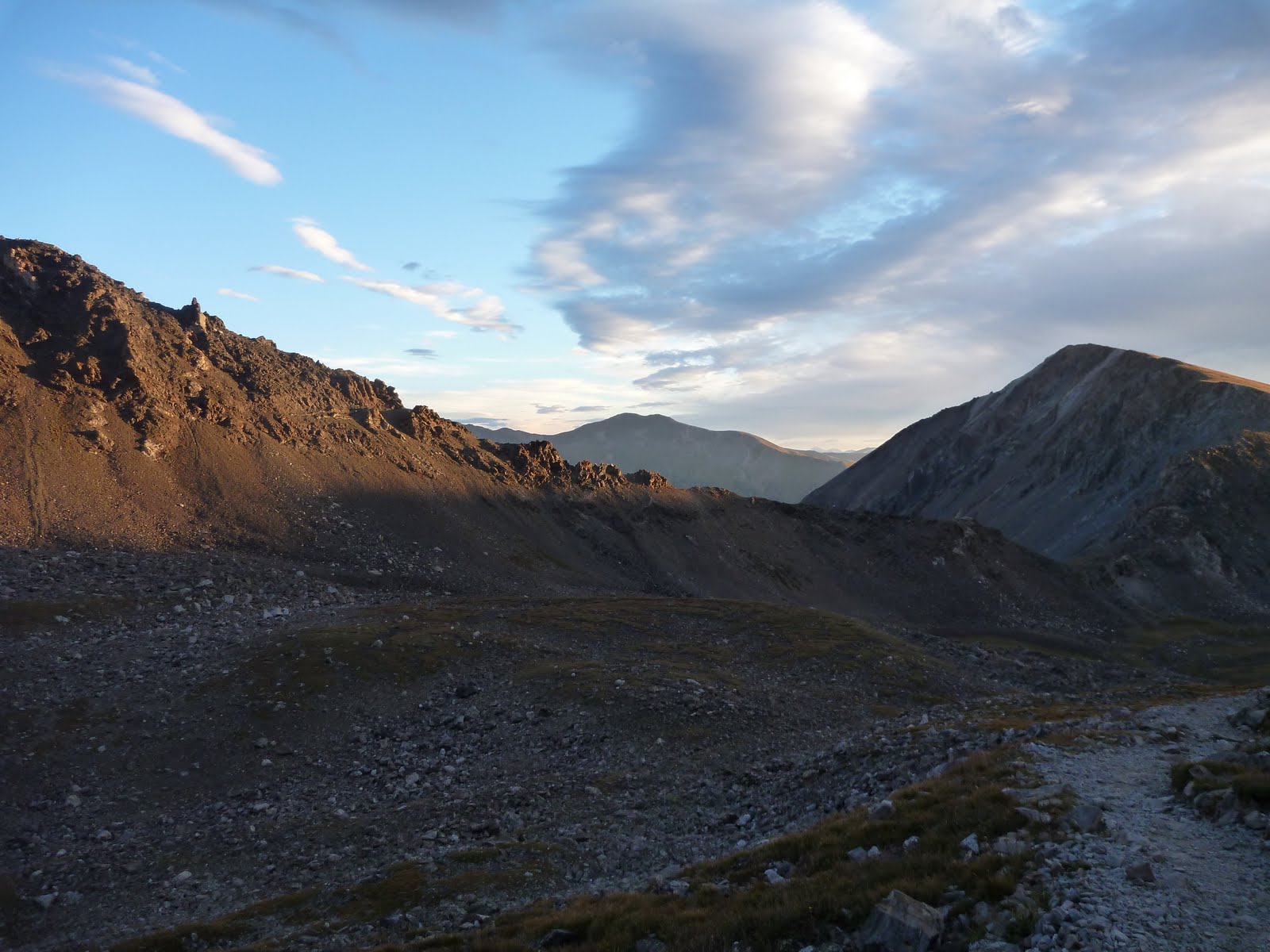
When the alarm clock beeps at 2:30 a.m. it is natural to question one's motives, even for those who are used to beating the sun by several hours to engage in bird or photography hikes. Bed seems awfully nice when the reason for that alarm is an upcoming 8 mile hike with 3,000+ feet of vertical gain, and a summit of 14,270 feet lay ahead. But, after coffee, picking up friends and gear, just over an hour of driving, and a 5:00 start; everything begins to make sense:


Sun kissed Grays (left) and Torreys (right) peaks


I had gotten a bit of a head start on my group, knowing that with my cameras I would be a bit slower once I started taking pictures. As a result I had these couple of views all to myself, a rare treat because later in the day there are literally hundreds of hikers lining these trails like ants.


Looking back past the shoulder of Torreys - beautiful country


Soon the views began to be paid for in vertical feet. The first half of the hike, up to my location for the first two shots was a relatively gentle climb up a glacial valley. From here though it was switchbacks right on up to the summit.


A view back towards the trailhead, including Kelso Mountain (center) and Stevens Gulch (bending behind it from the right) trailhead sits just back out of view behind Kelso Mountain


I climbed Grays back in 2002 or 2003, and it was painful. My boots didn't fit well, I was wearing jeans with no belt, and as a twenty something I raced up, suffered down, and when it was over and the blisters and soreness had passed I realized I really hadn't savored much while I had worked hard to get up there.
This year was different. Once I got up high I took my time, I tried to memorize the views, and capture the moments, not to mention I had targets on my hike. The first were Rocky Mountain Goats. I have seen this species while driving up Mt. Evans years ago, but not since I had begun keeping lists or taking pictures. It was a species that I wanted to get on a hike, walking into its environment, not just driving by. I got them, seeing a group first on the ridge shortly after dawn, when they were just brilliant spots of gold high on red rock. About halfway up the ascent of the switchbacks I got a closer look, and at that point I was glad I had brought 5 plus pounds of camera along.


Rocky Mountain Goat


There was an even more elusive target though, one that I had tried for an missed many times in the past, and had never seen - the Brown-capped Rosy-Finch.


Brown-capped Rosy-Finch


My fellow hikers were a bit surprised when I shouted "Brown-capped Rosy-Finch"! There isn't much air up there for shouting, but I found some. I cruised to the summit, knowing that I had already bagged my two target species on the way up. Then the celebratory picture at the top, I'm squinting on the left - 'note to self - wear sunglasses for future mountaintop pictures'.


Summit


With my camera gear I headed back down with a part of the group, while some headed on and bagged Torreys as well. In hindsight I wish I had done Torreys as well, I wanted to get back down to the willow clumps in the valley below to look for Ptarmigan. When I got to that section I found two White-crowned Sparrows, and nothing else. I guess hundreds of hikers can have that effect. Oh well, now I have a reason to go back.


2010 Count: 196
Lifetime: 241

Thursday, August 12, 2010

Point and Shoot - Images on Loveland Pass

Just a few shots I took with my point and shoot on the trip.


Loveland Pass is one of my favorite places on Earth. It has natural beauty, but also represents a gateway that I often pass through in the winter when heading up to ski country.

Not to mention, a road that is just plain fun to drive. It reaches its summit and the true 'pass', on the horizon in the picture above, just in from the left a bit. My truck is parked on one of the pull-offs in the lower right.
Below are two of the smaller lakes on the same (south) side of the pass. The larger lake that produced most of my close shots of the birds was upslope and to the left of this frame. There is actually a small parking area for the larger lake, so drivers in the know can actually park away from the roadside if they prefer.


Just for kicks, here is a shot taken out my open window of a thunderstorm at sunset while driving along US 40, towards Dinosaur, CO. My plan when starting the trip had been to camp north of Craig, Colorado at or around the Freeman campground in the Routt National Forest. Thunderstorms, like the one below sent me on towards Dinosaur. Be forewarned that if you do arrive in Dinosaur after dark the camping options are either poorly signed or non-existent. I drove on another hour and a half, and arrived in Fruita one night early. I decided to extend my camping at the local La Quinta Hotel to two nights - after starting the day at 3:00 am I felt I had earned it!

Mountain Gems


While walking the lakes near the summit of Loveland Pass on Sunday I had the great fortune to follow a trail through some willow habitat that was shared by a group of cooperative warblers. The immature female Wilson's Warbler above was just one of the many birds who watched me from the cover of the willows.


The young male displays more of the Wilson's tell-tale dark cap. This one shows the bit of olive around the edges, an indication that lead me to believe this wasn't an adult.
The warblers seemed to feel secure in their concentrated stronghold of branches, and would let me get quite close as I followed the trail along the lake before they moved on to their next perch. Gaps in the branches let us check out one another to our mutual satisfaction.


Wilson's Warblers weren't the only species enjoying the beautiful summer day in the tundra, MacGillivray's Warblers were also moving about in the vegetation.


I noticed that in this case they seemed to prefer perches on top of the willow thicket, making them easier to follow, but a bit more subject to harsh light. Even so, the segmented eye-ring is visible in the shot above.


Just to round out the previous post, here was one of the adult White-crowned Sparrows. As is usual above treeline, these birds were prolific. A great last stop on my trip, but not the last blog entry from that excursion by far. Stay tuned.....

Tuesday, August 10, 2010

Little help?


Here is one little bird that I had hoped to share, with its identity already confirmed; but once again I am stuck. If anyone has insights please let me know. The possibility is strong that I have missed something, but I will lay out my thoughts and pitfalls with the following pictures.


First off, this bird was seen foraging among wildflowers alongside one of the lakes on the Summit County side of Loveland Pass. I would put the elevation somewhere around 11,750 ft., but don't have that confirmed beyond association with the summit of the pass which is 11,990 ft.


The bird was just outside of some willow clumps, and was in close proximity to a handful of White-crowned Sparrows. It was quiet, or at least not vocalising loudly enough to overpower the wind and Pikas. Initially, I thought this was a White-crowned as well, just a young bird with a bunch of adults. As I began to double check though, some issues with that species began to arise.


First off, the bird is heavily streaked on the throat and underparts, which should be a solid light gray on a White-crowned; even a juvenile bird. Also, it seems that the dark crown-stripe drops down into the lores, (that area above and in front of the eye), too completely for an interior White-crowned. That pattern looks right for a Pacific, but again - the striping shouldn't be present.


To get myself a list for cross-checking I searched eBird records for some of the Tundra habitat Colorado Hotspots, and pulled a list of all the August results. The candidates I looked at more closely were; Chipping Sparrow, Song Sparrow, Lincoln's Sparrow, Brown-capped Rosy-Finch, Cassin's Finch, and Pine Siskin.
I believe I have eliminated each as a pure species for the following respective reasons. The Chipping Sparrow, coloring is wrong, and the presence of striping is not correct. For a young bird though, the head pattern was close. The Song Sparrow, didn't seem that likely, and on comparison this bird doesn't show the same pattern of breast streaking or a central breast spot. Its eye-line runs straight back, not curving down like that of a Song Sparrow. A Lincoln's Sparrow seems more likely for a hybridisation, with the buffy wash and more streaking, but this bird is lacking the neck pattern - specifically a strong malar stripe, central breast spot, and fine streak pattern for a pure Lincoln's. I looked closely at the Brown-capped Rosy-Finch mainly because I am still seeking one (unless one of my long range pictures from earlier in the trip turns up a hidden gem). Besides hope, there really wasn't much a Rosy could add to the process. The Cassin's Finch did have more concrete contributions, specifically the streaking on the neck and underparts, and a fairly plain face pattern below the eye. The strong eye-line and pattern on the back aren't right, however. Of course, when looking at streaky mountain birds the Pine Siskin has to come to mind. On this bird the bill shape, leg color, and lack of strong wing-bars make that species unlikely as well.


So, a 'pure' species of any kind still doesn't seem close, but again, I wouldn't be terribly shocked if I was missing something out there that fits. A hybrid of one or more of these species may be more likely, but I didn't find much documentation for some of the more likely pairs. Also, I had another bird that appeared to match this one, but at a greater distance, and with poorer light. It is possible that the same bird moved between two locations while I was shooting - or that the two birds were siblings, but that may make hybrid a less likely option.


I believe my best guess is some kind of Lincoln's Sparrow mix, but I haven't found clear indication about the malar stripe on a young bird of the species.
If anyone has an answer for me, please feel free to share. The tough birds are the ones where we learn the most, and I have been digging on this one quite a bit. Thanks for considering, and I will have more pictures from this spot shortly, it was a great stop.
Also, while searching online the past few evenings I have been unable to find a handy and reliable list of most species that can be found in the tundra area. The lists you find for Tundra habitat feature the handful of species that are common there, but unlikely in other habitats, such as White-tailed Ptarmagin, Brown-capped Rosy-Finches, and White-crowned Sparrow. Anyone know of a list where you could sanity check to confirm that the bird you thought was a Downy Woodpecker would be really unlikely up there. For instance I see Bluebirds with some regularity up at the Alpine Visitor Center in RMNP, but because they are much more common in lower parts of the list they show up in park lists, but are not associated with the Tundra habitat. If anyone has a list that they use, or just has built one up with more experience than I have and can point me to it I would appreciate it.

Tuesday, July 20, 2010

Arapaho Lakes - Fresh Air

Last weekend was a 'three day'r' for me, so a planned camping trip to the Arapahoe/Roosevelt National Forest was a key chance to beat the heat and enjoy some of Colorado's natural treasures. Yankee Doodle Lake - the closest landmark to our favorite spot - is close enough to the Denver metro area that friends can come up for whatever part of the weekend they are free, and get a one, two, or three night trip in. Knowing that it gets crowded on the weekends, three of us met at the spot on Thursday night to enjoy something closer to solitude than we would find when all those poor souls that had to work Friday showed up.
The drive from Rollinsville west towards the Moffat Tunnel on Thursday afternoon couldn't help but remove the work week cares and concerns. Cool mountain air and beautiful scenery will do that!


The next day, and we were off from the Forest Lakes Trailhead, to the largest of the so called Forest Lakes. This was just a half-mile down the trail, a brief stop where I pulled the cameras out and got down to business.


The cirque above the lake was beautiful, and hid at least one more lake above, but we were headed up through a boulder field, and along the ridge that extended southeast away from the steep valley head.


From the shoulder of the ridge, where we crossed into the next valley, offers a look back to the point where I had taken the picture at the top of the page. The light spot in the center of the frame is roughly the same area of marshy meadow that was in the foreground of my shot along the road.


After a couple of miles of rolling trail that took us over the previously mentioned ridge, and down through another swampy valley, we made one last brief climb to our destination, the Arapaho Lakes.


The lake is crescent shaped, and of fairly good size for that elevation. It has a smaller parent lake above the band of green vegetation beyond it, and a small pond separated by a small stretch of rock at the far end. It was on that area between the pond and lake itself that I got a chance to observe the White-tailed Ptarmigan and her chicks.

Looking back in the opposite direction - sky almost meets water, the soul is refreshed, and possibilities seem endless.


Who knows if it is the wildness of the area, the effort you have to put forth to get there, or just the thin air, but these are special places. They are infinitely different while you are there, than they are when you find yourself back at the trailhead even just an hour later. I know I can't wait to do it once again!

Monday, July 19, 2010

Arapaho Lakes - Fur


Back online - with a post that includes honest to goodness photographs this time!

Over the weekend I escaped the heat by heading up into the mountains with some friends. Camping well above 10,000 feet is a recommended activity when the thermometer is registering triple digit temps! On Friday two friends and I headed from a trailhead near Forest Lakes on a hike that crossed several ridges, hanging mostly around treeline.

The birding didn't include a lot of diversity, but had a real highlight that will be featured in a future post. For now though, the mammals get the spotlight. The critter above is one of my favorites in the high-country - the Yellow-bellied Marmot. Like the one above, they seem to really like perching on rocks and soaking up the sun. It makes them a fun photographic target.

This next mammal is a little less obvious, but a few minutes sitting still above the lakes let me get a few shots to welcome it to the blog:


The Pika. (PYE-kÉ™)


Pikas live in the Alpine environment, and seem to love scurrying around in the scree fields. Their coloring and small size makes them nearly invisible, only really showing up when they make a dash across an open space. Perhaps because of their well suited cammo they will perch in the open - so a bit of patience can pay off when they do reemerge from the rocks or their burrows.


Those big ears may make them look like cartoon characters, but listening for predators is no laughing matter. Pausing to take a look around helps to.

It never pays to stray to far from a nice safe crease in the rock - where shelter is just a hop away. For this little Pika there was no threat, its efforts gathering grass for a nest were undisturbed. I had a good time stopping to watch this one as it darted back and forth across the clumps of grass, hopefully I'll get a few more sightings before they hunker down for winter.