Showing posts with label Harris's Sparrow. Show all posts

Monday, February 7, 2011

Ridin' at the Refuge


Saturday's mountain snow reached the plains by the overnight hours Saturday, and I awoke to a fresh dusting of four or so inches. After a quick shovel of the drive I headed off to the Rocky Mountain Arsenal National Wildlife Refuge. It's been a while, so I am sorry if you have read my posts on this great location in the past. For anyone who has recently found this blog, or is not familiar with the Arsenal I strongly recommend it. This former farming community, turned weapons plant, turned petrochemical factory, turned Superfund site is quickly becoming a unique treasure of the National Wildlife Refuge system. As the Denver area expands it is becoming an increasingly surrounded oasis of prairie in the midst of human habitation. This spring the Refuge will see the grand opening of its new Visitor Center, and as each year passes the area continues to evolve to a more wild state.

I hadn't been out to the refuge since last summer/fall, and the fresh snow made it seem like an appealing destination. My drive in followed only a single set of tire tracks, and a Coyote welcomed me back as he sat near the side of the road. I approached the Visitor Center, and decided to check out the feeder station from my truck. Before I had even gotten started I had Western Meadowlark, Chickadee, Red-winged Blackbird, Northern Flickers, Black-billed Magpies, Song Sparrow, and scores of Dark-eyed Juncos. Of the Juncos, the White-winged is the race that I have found I see the least frequently.


So, I was happy to find one perching for me. Then, it like the others was drawn to the spilled seed on the snow.


I dropped into the Visitor Center to sign in, and found that the weekend tour was set to leave in fifteen minutes, and with the snow it was likely to be a small group. I decided to ride along. It had been just about a year since the last time I had been over to 'raptor row' or the Bison enclosure and I had hopes of seeing the light and dark Ferruginous Hawks again. (For those who have not been, the trailed area that is open to the public in the refuge is relatively small. The focus is on the animals, and they are able to live their lives more naturally with large areas where humans just don't go. Regular tours take visitors on a shuttle buss to see areas that they are not allowed to visit on foot.) While I had a few minutes to wait I wandered around what had been the Officer's Club (now the Visitor Center) to check some of the plantings and fresh tracks in the snow. Not many birds in the trees, so I completed my walk back at the feeders. Feeding there among the crowd was a first-year Harris's Sparrow.


Suh-weet! I have seen a handful of these largish sparrows, but all of them have been re-finds, where I went in with the hopes of locating a bird I knew had been in the area recently. This was the first that I had just picked out of a crowd - pretty cool.


The top of its head and throat will turn black in adult breeding plumage, and will merge with the necklace patch it has right now to form a backwards black hood. Here is a post that shows an adult bird closer to breeding plumage - note that it is a Harris's Sparrow, not a Harris Sparrow, it is possible to learn a few things over a couple of years. From the birds I have seen, Colorado mostly gets first or second year birds that have gotten a bit off course for winter. Typically this species overwinters just to the south-east, becoming more common into the eastern plains of Colorado.


With a great add to my list, to go along with White-crowned Sparrow, American Goldfinch, and Hairy Woodpecker, I was ready for a tour and some hawks! The group grew to seven, a ten year old boy and his dad, a couple of whom the wife had visited the refuge as a Girl Scout. "Back before they cleaned it up!" She explained to the boy, which was why she still "glows at night" Wink-Wink. There were also another pair of photographers to round out our crew. The stars of our trip yesterday were the Bald Eagles. Even a jaded birder like myself who was out for the hawks had to be impressed with the showing. My conservative count for the tour was a dozen, although I am guessing we had more but couldn't count some assuming they were the same ones that had just relocated as we drove. We had a nice mix of adults and juveniles of all ages. Many were perched in the trees, but we had a chance to see one on the snow over a kill, and others in flight.


My highlight was getting to see both the light and dark Ferruginous Hawks on the trip. The dark morph was just seen in passing, and I had no angle to get shots from the camera portholes on the bus. As seen below, the light-morph was much more accommodating. It appears that this light-morph is a recent addition to the area, last year's birds showed dark irides, a characteristic adults have but younger birds do not.


To close, I am guessing that this will be the highlight bird for everyone on the trip who wasn't floored by an eye-level Ferrug or a feeding Harris's Sparrow....


...the just above eye level Bald Eagle. This bird was 10-15 yards from the shuttle bus, and just sat as we stopped and then slowly rolled past. Beautiful, and a great reminder of just how large these birds are. Our tour did get to see a handful of Bison, although they were distant and fairly well hidden in the downslope area of their range. By the time the bus got back I needed to be heading out, but I didn't regret taking the ride. I did notice someone birding from a vehicle at the feeders, and walked over to say hello and ask about the Harris's Sparrow. The man said he hadn't seen one himself that day but that there had been two around, a first and second year. Impressive little feeding station they have going there.

If you are in the area and remotely interested in wildlife do check this location out. The tour ride is a great experience for anyone interested in wildlife or history, regardless of your knowledge level. The ride is really great for kids, but parents be warned that it can run almost two hours. Be aware that the refuge isn't a park. It is a wildlife refuge, and there are a handful of differences for the visitor to be aware of - so check out the site or give them a call during visiting hours.

I can't wait to get back for a hiking day, although at the >95% of the water is frozen, so waterfowl are very limited. On the flip side this normally quiet site is in its off season, so you will have an even more intimate experience during the coming weeks than you will once migration heats up.

2011 Count: 64
Lifetime: 252

Friday, March 26, 2010

Harris's Sparrow


One of the great technological innovations that I have relied on heavily in my year and a half of birding is the CObirds mailing list for Colorado Birders. If you are a Coloradoan and are reading this you probably are already a member - if you are in a different locale I hope there is something similar for you to find in your own community. For me the mailing list is a teaser list of what to watch for in the area. Now that I am approaching my second spring migration I have a bit better feel for what to watch for, but reading about the observations of others definitely helps me prepare when I head out to a certain area.

The list also conspires to make a 'twitcher' out of all of us. The mailing list grew from the Colorado Rare Bird Alert, which as I understand it was once upon a time entirely phone based. While the scope of the mailing list has expanded, the rare bird alerts still make up the meat of the archive. I have certainly used the rarity alerts to help me plan day trips to different areas in Colorado, but often chasing a specific species at my skill level doesn't pan out. To save on gas, and to make sure that I am birding my favorite places rather than just chasing species, I limit myself to following only those alerts that are consistent over time, or are conveniently located to somewhere I need to be.


So, last night when I read that a Harris's Sparrow had been spotted in the Greenlee Preserve, (one of my regular lunch birding spots), I knew that I would have to swing back by for a visit to try my luck. I had two strong things going for me if the bird was still around; I had seen it before in Iowa, and I knew the Preserve well enough to have a good understanding of the area where it had been seen.
Of course birding at mid-day, with patchy snow cover, and trying to see into the underbrush where the Harris's Sparrow likes to forage is still a formidable challenge. When I did see the bird I had a good feeling that it was what I wanted, but with the glare I had to rely on a series of frames to really confirm the field marks I was seeing.


In the adult I had seen previously, the black crest, neck and bib were readily distinguishable from a distance and in poor light. This bird had already been distinguished as a first year when I saw it, and that accounts for the blotchy black areas where the darker feathers are just beginning to come in. Other key field marks that are visible on a Harris's Sparrow are, the light bill and legs, which distinguish them quickly at a distance from the also dark bibbed, but much more common House Sparrow. The Harris's sports a long tail for a sparrow, and has black streaks mixed in its brown back and on the sides of its whitish underparts. Throw on a pair of white wing-bars and a dark spot back behind the eye, and you have a youngster on the way to becoming one fine looking bird.


It certainly is satisfying to head out to a location in search of a specific individual bird, one that in my experience spends most of its time at the base of thick bushy shrubs, and actually locate it quickly enough to be able to return to work after a normal lunch break. I for one am hoping that it decides to stick around for a while, but more than likely it will pass on as just an early migrant.

Tuesday, May 5, 2009

Trip Weekend: Orange City, Iowa


It only seems right that I should have gotten my first Orange-Crowned Warbler in Orange City, Iowa this one showed up and was hopping around just outside the window.


In a rare bit of good timing this Ruby-crowned Kinglet showed up while I still had my camera ready, although he did not move to any non-screened windows. In a Glamour Shots way the screen probably helped to soften all those wet soaked looking feathers.

Much later in the day my Dad and I joined my Brother-in-law to head out looking for a reported Cooper's Hawk a few streets over.

The reports had a Cooper's nesting just off the road. We headed over and shortly found the nest, with a head and tail just visible. It wasn't tough to tell what we were doing in the mist with bins and a long telephoto lens, but even so four different people stopped to make sure we knew about and had found the local attraction. It was a nice bit of Americana, right down to the little girl who asked if we knew about the "Red-eyed Hawk" in the neighborhood.

We had spent our time maneuvering around the nest and had just started heading away when I heard what I called a "Rubber Duck" sound from the tree just across the street. I had been standing below it a few moments before getting shots of the nest.

Looking up I spotted a second Coop' a dozen feet off the ground.


It had a recent kill, and as I have read was more content to remain perched despite our close proximity. I fired away and despite the poor light got some fun closeups.


We continued on our short walk, and were rewarded a few minutes later with more distant looks at Junior. My brother in law, who knows his birds, was surprised that a presumable offspring would be in such close proximity to his parents, but regardless it was cool to get such close and varied looks at the whole family.
The next day my Dad and I braved an even colder wind to walk a bit of the "Puddle Jumper" Trail to see if we could track down any Harris Sparrows. The last bird I saw before the stiff breeze coming across a freshly manured field drove us back to the car and a warm house in town was this Harris.


Just in time!
The bit of birding I got to do was fun, but getting a few days with family was even better! It is always a treat to get to spend time with them.
That wraps up the trip. The return trip was posted out of order and is visible in prior posts. I am so glad I had a chance to do it, and will hope to do pieces of it again. If you get the chance, I recommend Northern Nebraska.

Thursday, April 30, 2009

1st Post Trip Update (DeSoto NWR Visitor Center Trail)


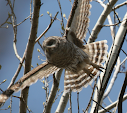
Wow - what a trip! My family visit to Orange City, Iowa, (the reason for going) was great and so were the birds. I have so many pictures that it is going to take some time to get through them, and in the meantime there are more migrants in Colorado, so here is one tiny sample from one of three sets at the DeSoto National Wildlife Refuge. By the way I saw DeSoto NWR on my AAA map while I was driving south on US 75 in eastern Nebraska, I had no idea about it, and decided that I would break up my day's drive to Grand Island by stopping there around lunch. I spent 5 hours and took over 5 Gb of pictures there while birdwatching in two states. The highlight of which was the Barred Owl above.
I had no idea about Barred Owls, and happened to spot this one just after I had thought..."Hmm haven't seen a Great Horned in a while." If only that though would work this well every time. Just one of many lifers on the trip, and I still have three substantial counts to submit to update my tally.

I'm not even sure if this is my best Brown Thrasher picture, but they were a FOY for me.


I had a lifer Harris Sparrow the night before on a cold and windy walk in Orange City. More on the hunt in scrub brush to find them later - but the next day these two were just out and about in front of a picnic table right next to my car.


Not the best of pics, but the colors of the White-Throated Sparrow stand out so well, even in a blurred flight shot.


Then there were Cedar Waxwings all over a flowering apple tree just above the Harris Sparrows next to my car, I mean really I have been spoiled.
More picture updates to follow, but for now:
2009 Count: 112
Lifetime: 129