Showing posts with label California Gull. Show all posts

Sunday, January 9, 2011

Ski Trip Birding


My first trip of 2011 was primarily a ski trip. Waking up early to catch the gondola, trying to cover as much territory of the destination resort, and spending time with friends were the real goals. Then again, California is a state I hadn't visited since I began birding, and spending a few days in a hotel located on Stateline Rd didn't hurt. I managed to keep my eyes on the treetops while riding the chairlifts, and took the camera along for afternoon walks to the lake shore, and was able to build some respectable winter lists as a result. The Pygmy Nuthatches, (above), moved about in flocks, much like they had when I watched them a few weeks ago in Boulder. In California, like Colorado they show a preference for the Ponderosa Pines.


The Lakeshore Park was popular with many of the tourists, not just photographers and birders. The children feeding bread to the birds pulled in a nice mixed flock of gulls. This Herring Gull remained aloof from the frenzy on a closed diving pier.


While the lake was the bird magnet, time spent on the slopes wasn't birdless. In the Sierras just like the Rockies it pays to keep your eyes open while enjoying some sun and lunch. A pair of Clark's Nutcrackers (above) and numerous Mountain Chickadees kept a close eye on the happenings at the new Tamarack Lodge near the summit base of the gondola, just on the California side of the border.


What trip to California would be complete without California Gulls, on the south shore of Lake Tahoe they even outnumber Ring-billed gulls - a welcome change for this Colorado birder. I think the bird above was disappointed that my camera did not generate scraps of bread.


Finally, who couldn't fall in love with a view like this out their hotel window? I've been to Tahoe before, and will plan to get back just as soon as I can, perhaps in a different season next time.

2011 Count: 23
Lifetime: 252

Tuesday, October 19, 2010

Birds from Last Week

Prior to watching the sun set last Wednesday I had done some actual birding as well. Here are a few of the shots:


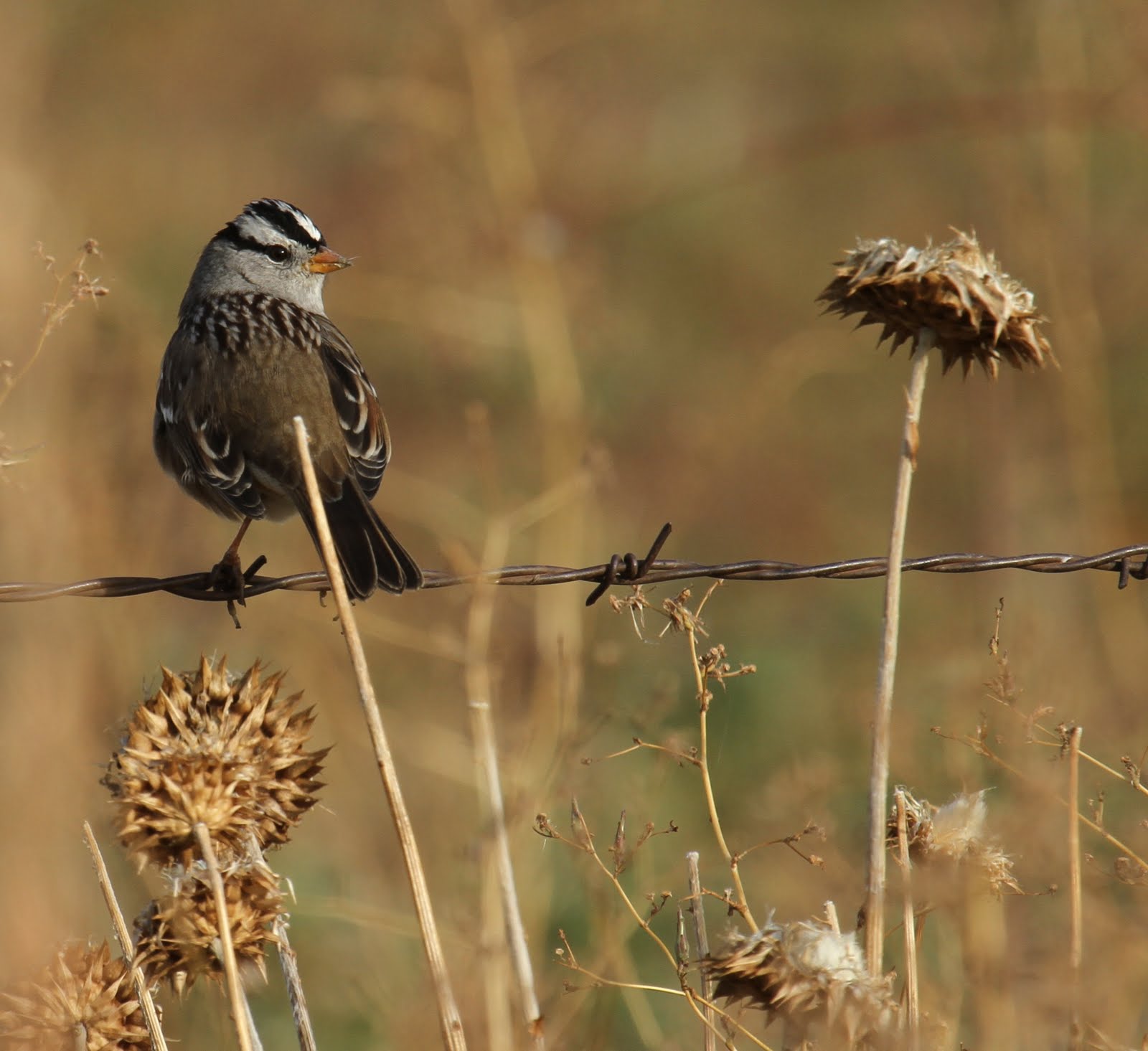
A White-crowned Sparrow working on dried blooms.


A female Ruddy Duck, the white cheek with a single dark line through it help on this species.


California Gull in flight.


Ring-billed Gull in flight.

Birding hasn't happened for me since, and I have been missing it, despite being busy doing other fun things. Hopefully this weekend, although the opening date of a certain mountain ski area may have an impact.

Monday, March 1, 2010

Morgan County Day Trip

On Saturday I decided to undertake a self-guided birding excursion. It was to be the better of the two weekend days, and I wanted a chance to really get out and enjoy the high plains environment, beyond the urban sprawl of the Front Range corridor. Flipping blindly through my Colorado atlas, and doing a bit of reading on the Colorado Field Ornithologists' birding website, I decided to head out to Morgan County for the day.
Morgan County is a 'smallish', rectangular county in Northeastern Colorado. It is the next step east from my large, neighboring counties of Weld and Adams. The county features a state park on a good sized reservoir, a well developed agricultural and commerce corridor bordering the South Platte River, and it is handily located along interstate I-76 - making getting there a snap.


My first stop, and main birding area, was Jackson Reservoir State Park. Having left my home at just after 7:00, I was pulled in and counting birds before 9:00. My first sighting in the park itself was a male Ring-necked Pheasant. A good sign of things to come, but on this outing the photography was taking a back seat. I was trying to lean a bit more on my ears and bins first, and get shots as an afterthought. It was a good decision, when I got back that evening I found that my sensor had somehow picked up a collection of dust to rival the area beneath my bed - yuck. Despite that there were a few pictures worth sharing, and species that didn't make the cut.
Above were a group of gulls taken from the pier on the west side of the lake. It was near an area of open water that had some great birds hanging out. Before getting to the gulls in the picture believe me when I say that my report of 48 Bald Eagles was conservative. I had to stop looking for species after I had arrived and just do a sweep of the area to count individuals before they moved around too much. Adding to the impression of the sight was the fact that only 10-15% of the lake was open, so the birds were gathered in a small area of the rather large lake.

Back to the picture above though. I caught the two gulls contesting a catch which was fun, but check out the darker guy on the right - a California Gull. I tallied the California, a good number of Herrings, and of course Ring-billeds at the park. Three gull species, not bad, I guess my gull watches are having some effect.

Gulls are still frustrating though, so lets pause to admire a posed Dark-eyed Junco. "Ah, that's better." The Juncos were part of a loose mixture in the trees as I cam back from the pier. I had American Robins, Mountain and Eastern Bluebirds all interacting with them. The Eastern Bluebirds were the first that I had seen in Colorado.
After checking some of the Russian-Olive groves in that area I met another birding couple who mentioned having had a group of 7 Long-eared owls fly into the trees near them back near the visitor center. I stopped by on my way out of the park. I never saw the owls, but enjoyed this odd moment of nature from the parking lot. Two tom Wild Turkeys were displaying and competing with one another, but were separated by a chain link fence. I have no idea how long the dominance display lasted, or if in a Turkey's mind such a thing can be decided when there is an incomprehensible barrier dividing rivals. It was good for a watch though, and more comical as there was a large opening in the fence just to the left, but these two were so hung up with one another that they may still be there now.


After a very enjoyable time at the park I headed off for my next target - a pair of adjacent parks in Fort Morgan along the South Platte, one of which was appropriately named Riverside Park. A pond there had the full compliment of exotic waterfowl, along with high numbers of both Canada and Cackling Geese. Riverside Park was a bit overdeveloped and crowded on a mild Saturday afternoon, so I headed for the more natural Canfield Park. I had to work for birds, as my walk out was pretty quiet, but eventually birds started appearing. The river itself was strangely dull. I saw 6 Mallards and 11 Killdeer on the banks or in the water, and that was about it. On my return trip I stayed more inland, and was rewarded with more cooperative subjects, like this American Goldfinch.


As I turned from the Goldfinch a Wilson's Snipe exploded from the bank of a fishing pond behind me. A few minutes later a fisherman on the far side flushed it again, and it landed briefly in the open to allow a single shot in the light.


As I walked along I added a pair of Downies and dozens more Red-winged Blackbirds, and got this shot of an Eastern Bluebird posing with the sun at its back.


It was now mid-afternoon, and I had one more area I just had to check out. One of the locations the CFO site listed was a winding county road that cut through the dunes in the southern portion of the county. I wanted this route as it was reported as a great site for raptors, and who doesn't like winding country roads through dunes?
On my way south I picked a road at random from my atlas, county road "Q", and drove east. It was while I was on this road, trying to reach my target while swinging past a SWA, that I witnessed a site that many are inspired by, hundreds of miles away at Bosque del Apache. That site was the rising of thousands of white geese from a reservoir that was dammed immediately to my right. Because the light was fading my pictures were a sad display, but I will be back in the area again to try to do justice to what I was able to witness. Just incredible!
To that end, if any reader happens to know the area, please feel free to reply to let me know if the large processing plant on the south side of that reservoir has any public access to the lake? It is just south of County Rd Q, and west of the Brush Prairie Ponds SWA.
In the fading light I did head on, and reached my target road. I saw no one for ten miles, just two dogs that chased me for a mile or so, and one Red-tail Hawk. I wouldn't have traded the experience though. At one point I stopped to pull a jacket from the back seat, and got out just to listen to the silence. I wasn't rewarded with any sightings, but that didn't matter right then. Finally as I was returning to a paved State Highway and turning back to the interstate in the cloud induced early dusk I had a pair of Harlan's Hawks, one flying and one perched, in my area. A good sighting to wrap up my first of many visits to Morgan County. The hundred Ross's Geese I saw added one life bird to my list in force. I had hoped for photos, but there should be more opportunities as migration approaches.


2010 Count: 70
Lifetime: 207

Sunday, February 21, 2010

Gettin' Back: Gloomy Day Gulls

Long time, no blog. Some kind of bug kicked my butt and kept me in bed for three days. I had gotten in a hike on Monday afternoon, but other than some Chickadees, a large flock of American Robins, and a few Ravens overhead there was little to report. I did see a nice Ferruginous Hawk on my drive back from Boulder County, but puling to the side of a busy highway only allowed me passing looks from a distance.
So after three days of sleep and a long Friday in the office, I was ready for some pond hopping where the focus was on scrutinizing gulls, rather than a whole lot of walking. After reading more reports from others about the Glaucous and other uncommon gulls in my own home town I had to give it another shot.
My most productive stop was once again Indian Peaks Pond, where this time arriving at mid-day showed me much larger flocks to scan through. I think I am getting better at picking out the Herrings and occasional Thayer's Gulls, but the bird below gave me pause:


I believe that it is a California Gull. It is darker than the Ring-billeds around it and slightly larger - and it had the black ring with red spot on its bill. As always, if I am wrong please leave me a comment or email to let me know where I went wrong. Gull ID sessions usually take me hours, flipping back and forth between species across numerous different guides. Not necessarily a bad thing when half watching Olympic coverage.
Next up is one of the rare birds that has been seen repeatedly in the area.


Here we have a Lesser Black-backed Gull. In addition to the obvious darker coloring and red spot on the bill, take a closer look at the bill and leg color.


It is described as a bright yellow color by Sibley. Despite the darkness of the day and the loss of some color clarity, the difference between it and the Ring-billed bill is clear.


Finally, amidst all the snow and dreary skies this Western Meadowlark was showing off its new breeding plumage. My picture failed to show just how bright that yellow appeared against the snowy background, but it was a literal 'bright-spot' in an otherwise drab day.


I still failed to locate the other rare gulls, but considering the movement of gulls between the numerous reservoirs, lakes, and landfills in the Broomfield-Boulder area it may still be a while.

2010 Count: 63
Lifetime: 206

Thursday, July 30, 2009

Goin' on a Photographic Moose Hunt

Wilson's Phalarope

Last evening I caught the local news, and was amazed to hear that a moose was being monitored in my home town of Broomfield! In several recent posts I have mentioned moose. On an early June camping trip early risers were treated to a view of a moose cow walking just past the turn off to our camp, as I snoozed. Later, I was disappointed to learn that I had just missed a cow and calf on the western descent from Trail Ridge Road. Those I easily deal with, because I have seen moose in the past, and don't expect that I will see them each time I am out. It makes it that much more special when they are sighted.

Well one in my own back yard was too much to pass up, so I started out early this morning to see if I could catch a glimpse of what I believe is the second reported sighting in Broomfield since the species was reintroduced to Colorado.

Sadly, while I later confirmed that I was in the right area I did not see it. I was easily consoled by my stop at Prince Lake #1 in Boulder County on my way to work. The Wilson's Phalarope above was just the first lifer I had this morning as I braved the cool temps and varying precipitation of an October-like July morning.

California Gull

Also added to the list was this California Gull. It was in the mix with about 85 Ring-Billed Gulls, but was distinctly darker even from a distance. Anything not a Ring-Billed is a welcome sight for me, but I am still as novice as it gets in Gull ID. If anyone reading is sure I am incorrect after looking at these two pics, please don't hesitate to let me know.


If there is anything I am less sure of in identification than gulls, it would have to be shorebirds. For the Wilson's at the top of this post I am very confident. This last one is still a mystery to me as I type.

Update: After some quality time with "The Shorebird Guide" by O'Brien, Crossley, and Karlson I had a forhead smacking Spotted Sandpiper epiphany. Leaving the original text below because the notes I had on behavior were so indicative of this species. I have to get used to them losing their spots!

Granted I have only had my Peterson's Guide to Western Birds, (my bag book), to check so far. The coloring and bill length suggest Mountain Plover to me. When I checked BNA Online I found that they are rarely seen around water. While this species stayed more to the mud flats than the Killdeer that were all around, they were definitely in a shorebird area rather than the plentiful prairie and scrub habitats in the area. Then again with all the rain we have gotten in the past few days those habitats may be equally muddy, leaving the potential plovers to mix it up a bit and get some inter species socialization in while they have a chance. The two individuals I observed were much more mobile than other shorebirds. They seemed to be following clouds of flying insects in fairly straight lines across the shore. They moved quickly, and somewhat constantly without much bobbing or checking of the ground. Their size was close to the many Killdeer amongst whom they were moving, but they were more streamlined.


If this is a no brainer, or if you have a strong conviction about what this species is please feel free to leave a comment or send an email.


2009 Count: 170
Lifetime: 180