Showing posts with label Broomfield County. Show all posts

Thursday, November 17, 2011

Snow Geese


This morning I was running early on my way to work. Mainly because there was no frost on my windows. Then, in an incredible struck of luck, I spotted two immature Snow Geese in the field outside my neighborhood. This field has a near constant flock of Canada Geese in the fall, winter and spring, and despite my constant scanning - they always remain Canada Geese - unless of course there are a smattering of Rock Pigeons thrown in for good measure or spite.


Not today though - real, live, Snow Geese! Two of them! Why did the Snow Geese pick this morning to appear? Because this morning, @#$%, I had left my camera bag at home!
"Don't leave Geese!" I thought to myself as I made the split decision to correct that oversight.
I find it amazing that anxiety can reach such levels in moments it took me to turn back into my neighborhood, navigate safely to my house, retrieve my gear, drive back to the edge of the neighborhood, park, cross the divided two lane street on foot, and then, (having confirmed the birds had not been chased off by a happily walked dog), walk along the field to a position where I was not shooting into the sun.


Needless to say, I was happy they hadn't picked those few minutes to leave! Both birds, the second is visible in the top picture - facing away and feeding (AKA the moon shot) - are first year birds, and are trading out their dark plumage for the snowy white feathers they will show for the rest of their lives.


In addition to switching to their 'snow' white plumage, the birds' bare parts, (bills and feet), will turn mostly pink, except for the grin patch on the bill which will remain dark. Check my previous Snow Geese posts for adults in traditional and 'Blue' phases. This bird was nice enough to stretch, showing off the dark primary feathers on its wing, which will remain dark, but are generally hidden when it is standing or swimming and the wing is folded. These were my first juvenile Snow Geese, first of the year Snow Geese, and the first time I had seen more than one at a time in my home county. Not a bad way to spend a few extra minutes before work.


On the topic of good sightings, John Vanderpoel, a Colorado birder, is really tearing it up on his Big Year bid, if you haven't seen his blog yet be sure to check it out in the next six weeks. I have a feeling it is going to be a wild ride down to the end of 2011!

Friday, May 27, 2011

Owl Update & General Birdliness


This morning I swung by the neighborhood owl nest area, and sure enough the young owls have fledged. I had a couple of minutes and was listening and scanning for other birds in the area when I saw another woman who was obviously looking in the same area. In a quick chat she confirmed that the birds had been around since leaving the nest, and that she had seen them as recently as two days before. I spotted the young bird above shortly after, clicked a few frames and waved the woman back over. As she was approaching I saw the adult I had missed sitting on a branch a couple of feet and directly above the younger bird. A few moments later I found another young bird several trees over in a more exposed spot.


I am aware that these birds are still pulling a lot of human attention. I imagine, but haven't confirmed, that this is a rough time for owls if mobbing by other species occurs so I kept my looks brief and then focused my attention on the reservoir. Since Redhead Ducks and Yellow-headed Blackbirds are self explanatory I'll use the rest of this post to share a handful of my non-photographed recent observations.


On Wednesday evening, heading home from work, I was able to watch the leucistic Red-tailed Hawk (blogged here, and again here,) circling above the intersection I was stopped at. No chance for photos, but an impressive sight nonetheless.


While doing a bit of tuning up the backyard for the annual Memorial Day BBQ/party I have added a couple of birds to my limited yard list. Wednesday evening a flight of three American White Pelicans flew low overhead, and last night while I cleaned up an old brush pile I had one each of both Red-winged Blackbird and Blue Jay. The trees in the neighborhood are continuing to mature, so there is a bit better chance for more diversity this year. I have moved the thistle feeder from the front porch to the back yard, which has made the American Goldfinches more visible this year as well.


Now I just need to rig up a few spots for the Wingscapes cam so I can multi-task my birding! I also need to figure out a good spot for the hummingbird feeder I used in Estes Park last spring but have never hung at home.

Wednesday, May 18, 2011

Out on a Limb!


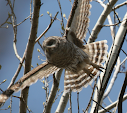
Back for a quick peek at the local owl nest between showers this morning. The family is still around, when seen between the thickening leaves.


Everyone was still hanging out on the nest....or were they?


Nope, this owl at least is out seeing the world! Actually those few feet are a big development. These owls are getting close to becoming airborne.


My guess is that they may well be off before I am back in the area next week. Hopefully they continue to provide interest for the area residents between now and then.

Monday, May 2, 2011

Heck of a day!

Sunday's ski plans fell through, so based on my success the day before I decided to head up to the Walden/Sawhill Ponds/Cottonwood Marsh complex in Boulder for the early morning hours. After Saturday's bright skies and bitter winds the calm overcast and quiet of Sunday was most welcome.


When I arrived I had the place to myself. The sun was just rising, but light would remain an issue for the morning due to the low clouds. Light and iffy photography aside I was in for a treat. By the time I left the park I had tallied 47 species, more than likely a new best for a solo bird walk of just a few hours in one location. Tops among everything I saw was this Long-billed Dowitcher, which I saw very early, just as I was crossing the boardwalk going into the complex. The bill shape narrowed down the possibilities, but I had my doubts after scrutinizing the first picture and checking the guidebooks. Shape and structure were great for the Dowitcher, but a Dowitcher in May should have a rusty orange breast in its breeding plumage. I felt better once I made it to this shot.


A longer exposure blurs the detail, but begins to show the coloration on the shaded side of the bird. Yet another example of how photographs can be misleading for identification. Fortunately, a bird with a long bill with a downward pointing tip doesn't have many options here.


A bit later I came across another shorebird to identify, this one I was more confident to guess in the field, and confirmed later as Solitary Sandpiper. The bird's shape, and the fine light specks on its dark back are good fieldmarks to set this sandpiper apart.


I was back home sorting through pics and wrapping up a few to-do items for my trip this week when I decided to check COBirds before running a couple of errands. Much to my delight I saw a message that was less than an hour old indicating a Black-necked Stilt was near Stearn's Lake, and a minute's detour from my route.


So two life birds in one day. One was produced by concentrated birding, looking for migrants at as known hotspot, and then using technology to record and reconfirm my sighting. The other, a word of mouth sighting that was incredibly easy to refind. BI was back home sorting through pics and wrapping up a few to-do items for my trip this week when I decided to check COBirds before running a couple of errands. Much to my delight I saw a message that was less than an hour.

Both were memorable, and filled out a very birdy beginning of May. I have a handful of potentially postable pictures, but may or may not get them listed in the next few nights. Although if the snow showers continue I may be looking for indoor activities to pass the time.

2011 Count: 128
Lifetime: 257

Friday, April 29, 2011

It's Friday!


A mixed bag here. Wood Ducks are awesome! I was able to see three of them yesterday as I birded the Wheatridge Greenbelt along Clear Creek. I was hoping for a pile of migrants, but didn't end up finding many. There were a handful of Audubon and Myrtle Yellow-rumped Warblers late, but otherwise most of what I saw was similar to the past few weeks of birding.


So I had to be consoled by seeing two of the most striking waterfowl species in the area. (Three if you count my distant looks at a Cinnamon Teal preening in good light). These Hooded Mergansers found themselves too close for comfort to my course along the path and were putting distance between us. They were moving a bit too fast for clarity with the camera setting I selected, but were close enough to imagine the scene.


Wood Ducks, with all their color, could keep me captivated for hours. Despite their appearance these brightly colored ducks aren't very comfortable in the spotlight, and offer fleeting looks at best. Daylight faded, and although I found a perched Great Horned Owl that a group of runners had seen further along the trail the lack of light kept it from being photographed well enough for posting here....So, I found myself due for a nest check-in this morning.


Check out that foot! I left the nest after a quick visit this morning thinking I had gotten no greater detail than some less gray colored nestling lumps. Imagine my surprise when on looking at the shots I saw those toes. Anyone care to do some rampant speculating? Do young birds roll around and sleep in weird positions like puppies? Or, is this a more gritty view of the reality that in bird rearing the weak are often literally held down by the strong? If a foot view is any indication it seems that the upside down bird is almost ready to do a bit of killing. Perhaps just a stretch that felt oh so good?


At one point the upright bird did turn its head, (I believe to check on a garbage truck across the busy street), confirming that the foot did belong to at least one other bird. The adult, meanwhile, seemed to have no interest in me glancing my way once and then turning its attention elsewhere for the minute or two I was around.

It will be interesting to see how much longer the nest remains occupied. My novice impression is that the fledging approaches.

2011 Count: 115
Lifetime: 254

Wednesday, April 13, 2011

Guess Where I Went Before Work this Morning!


Yep.


I was back to see the owls. Now the story. After last night's tease I set the alarm for well before five, and headed back out before light to see if I could do any better with the owls. I set up a blind, and had the scope dialed in on the nest as I preset the camera and scanned for activity with my bins. This morning the serenade and much more detailed scope view was even better. A returning parent announced a coming arrival with a series of hoots - but then waited for the chicks to perk up before approaching the nest. They started moving a bit and did a bit of stretching before the parent returned. I was mostly obscured in the by the angle of the parent in the blind, but was amazed as I observed the lower feathers spread like a veranda over the nestlings as they fed. Once breakfast (or is it dinner for owls?) was over I broke down my gear and headed back for the truck. As I packed everything up I noticed that there was a bus stop just below the nest on the side of the busy street - one stop down from where I used to wait at times. I made a long loop along the road to see if the view from there was any better. The results tell the tale. A rider was waiting as I grabbed my few shots, he asked what kind of owls are those. I told him and then zoomed in on a couple of the shots to show him the nestling. Hopefully it jump started that guy's day like it did mine!


I'll give them a bit more time as a break, but will try to get back again before they fledge. This owl nest is in a very public and highly trafficked area. I have approached this nest a bit more closely than I normally would - doing so only at the bus stop where humans stand every thirty minutes or so in the mornings. These owls chose the location, and the site has been a successful one for owls and raptors in past seasons. There is a social shortcut trail that cuts almost directly beneath the nest, which I have avoided, but was still being used frequently this morning. These owls are well conditioned to humans, but will still keep an eye on the camera 'eye' when it is aimed at them from such a close range. If anyone decides to try to observe these owls, or similar nests in their area please be considerate of the animals' needs and move on quickly. Or better yet, pull back a ways and view from a scope within a blind. I am thrilled with the images I captured today, but keep reliving the interactions I witnessed through the scope in the hour or so before.

Overcast, but Full of Possibilities

As I had mentioned in my previous post I was looking for the Avocets, and a reported Great Egret at the small drainage ponds behind the King Soopers in Broomfield. I was 50% on those two species, but on a gray spring evening there was plenty to see.


A Say's Phoebe, a flycatcher that can often be seen on any lone tree or shrub rising up above an open grass area, was back and making a feast of a very active and healthy insect hatch. The overcast allowed me to catch the motion of the flight, but kept the detail to a minimum.


The light was fractionally better as this Killdeer noisily arrived on the near bank. After I had circled the ponds and made sure I hadn't missed any other species of shorebirds I decided to head north past a large open space to McKay Lake, where I thought an Egret may have moved on to. I didn't find an Egret, but did add another grebe for the season, this time a Western Grebe.


I wandered back and forth through the clump of woods on the north side of the lake, hoping to catch an owl getting an early start on the night. After an hour or so I abandoned the plan, and in consolation decided to stop by for a quick peek at my 'neighborhood' owl nest. We had an inch or so of pea sized hail on Saturday night, and I was curious to see if that had any effect on the inhabitants.
When I arrived I was concerned, there was no sign of horns above the outline of the nest. Had it been abandoned? I walked closer with my bins and camera, and checked the trees to see if I could make out a silhouette in the trees against the lighter sky in the distance. Still nothing, but then I began to hear a wonderful duet, both adult owls, one from somewhere in the trees, and the other from atop a lamppost over a busy street began to hoot.
At first I was a bit bummed, if they were hooting I thought their nesting attempt may have failed, and they were reacquainting for another attempt. Then, the owl on the lamppost dove almost straight down to the roadside. After returning to the lamppost, and more hooting I suddenly caught motion again:


Both parents had returned to the nest, and each took turns feeding the hungry nestlings. There were at least two, and maybe three there, and after a few excited minutes watching I left them to their dinner.


I left giddy, the owls were doing well enough to be seen over the top of the nest, and hopefully I would be able to see them again with more preparation.
I had one more fun surprise, the last photo above was taken with ISO and Exposure Compensation dialed way up, as the owl had been perched at the top of the post, with a lighter sky behind. The additional light from the streetlight itself was enough to freeze the owl, while the panning and noise gave the background an impressionistic feel. Gotta love gettin' lucky!

American Avocet - What are you doing?


I am a big fan of American Avocets! (They are a big, easily distinguished shorebird with cool coloring, what's not to like?) So when I heard that dozens of them had been seen along with a Great Egret in Broomfield yesterday I decided to head over after work. The Avocets didn't disappoint, although the weather did, and the Great Egret was nowhere to be found.


When I arrived there were 15 or so of the birds spread between the three ponds. They were generally paired off, but seemed to still be sorting those associations out among one another. There was plenty of noise and commotion when six or more birds would get close to one another.


These shots had me wondering about this Avocet. American Avocets are ground nesters, and build their nest by first scraping and then lining a nest area on a clear area of shoreline. Or so Birds of North America Online tells me.


This bird seemed a bit early in the process though, and hopefully will give a bit more though to location. I would think that the multitude of predators in the area would make quick work of any eggs left on that bit of shoreline. My reading also indicated that males will do more nest searching early on, and that some of it is ritualized as a part of courtship. He, (if he is a 'he') seemed to be the only one showing off any digging skills. Hopefully his lady was impressed by his bravado, and will let him know that his poorly executed effort was appreciated!


I enjoyed watching these colorful birds, and hope a few of them do find good nesting spots in the area. The American Avocets were great to observe, but they had competition for my attention...

Friday, March 4, 2011

Good Morning!


Yeah, I checked back in on the nest this morning. I approached from within the neighborhood across the street and was able to get these shots from a distance, and without having to approach the nest in the open any more than from a ways down the street. Even so, I'll be leaving them to it for a while now. There will be plenty of activity around that site, and I'll keep from aiming a big lens at them for a bit.


Besides, there are more signs of spring showing up at Lower Church Lake each morning. Today it was a pair of Cinnamon Teal.


They were mostly keeping to the far side, and a cloud bank had blocked the direct sun by that time, so prettier shots of Mallards and Red-winged Blackbirds were kept to a minimum. I find the Cinnamon Teal absolutely gorgeous. It was too bad the sun wasn't shining brightly today, I doubt this pair will remain there through to Monday. Even so, seeing this pair on the fourth is roughly five weeks ahead of when I spotted my first Cinnamon Teal last year! That means a lot more chances to find them again and get more shots to share. I checked eBird to see what the bar charts had to show for Cinnamon Teal presence in Jefferson County, and sure enough, the first week of March is what came back for a first week in the spring - so it looks like the first arrivals are right on time.

On the other hand, here is a bird that seems really early to me:


I have seen this bird twice, once on the 23rd, and again this morning. My shots on the 23rd were worse, the tail was in line with the body and gave no impression of size. That day however the bird was vocalizing, and didn't sound anything like a Common Grackle. It had a staccato type sound to it.

This time the bird was quiet, but was perched in the same tree before it lifted off for this flight. Both sightings have made me think Great-tailed Grackle on the site, but I always labor over those judgements after the fact.


For this one eBird is a little less helpful, in a bar chart comparison between Common and Great-tailed Grackles for Jefferson County, the chart shows Common Grackle sightings beginning in March, and Great-taileds picking up in April.


To get a bigger sample I expanded the charts to pull from Adams, Boulder, Weld, and Jefferson Counties. With that change Common Grackles show about the same arrival pattern, but for Great-taileds a new pattern emerges, they have a lower frequency, but it expands and becomes almost stable throughout the year.


My counties made me nervous though, Weld County is large, and it runs well out to the east from the eastern edges of Boulder and Broomfield Counties. So, just to see if it would make a difference I then swapped Weld for Broomfield County.


A slight difference, but the pattern seems to hold up.

Moral of the story....I have no idea. I do know that I had been concerned that my instinct was completely wrong. I certainly have more experience with Common Grackles than Great-taileds, but was fairly confident after seeing the bird a second time that it was a Great-tailed. My narrow view of just the Jefferson County birds last week had led me to believe that I was pulling out a bird that really shouldn't be around. With a species that is tough to distinguish in the field I tend to the conservative choice, or just let it go as a bird that couldn't be ID'd. This one had bugged me though. Birds can be out of place, if they weren't the Ross's Gull that visited Colorado this fall would have never been here. Even so, when I check a bird and find that there are no other records of the species in the county for another month I question myself first.

The explanation....I don't know, but Lower Church Lake lies about as close to the eastern edge of Jefferson County as possible. My best guess is that because Jefferson County extends to the south, (developed) and west, (higher - eventually reaching well up into the foothills), it is not ideal Great-tailed habitat. I recall reading that the species is slowly extending its range. Perhaps these sightings will become more common over time. Either way, I feel better knowing that at least a few of these birds are being found in the surrounding counties on a regular, if infrequent, basis.

2011 Count: 73
Lifetime: 252

Friday, November 19, 2010

Digiscoped Snow Goose


Driving home this evening I caught a glimpse of white among some feeding Canada Geese in the Broomfield "field". After wondering while waiting at the next light whether I had seen a plastic bag or a bird I decided to take the chance and head back for another look. I pulled into the conveniently located historical farmhouse parking lot and had a great look at a smallish white goose.


Fortunately today was the first day I was ready with a new bit of technology. A spotting scope and adapter now allow me to join the ranks of digiscopers - hopefully giving me an opportunity to get more detail on distant birds, and as a result some more tricky ids in the future.


In the field this evening I was leaning to calling this bird a Ross's Goose. It was smaller than the surrounding Canadas, and appeared to have a small bill. Glad I had pictures! Note the forehead of this bird. A Snow Goose's head continues up from the bill along roughly the same angle as the bill itself. For a Ross's Goose the forehead rises more sharply from the top of the bill and shows a bit more angle. The other solid field mark for a Snow Goose is a grin patch on the bill. The grin patch is a dark area on the bill itself that gives an impression of an opening. The low light of the evening didn't really allow the feature to show, but I believe close zooms reveal it to be there. From all this I come away with the feeling that this is a Lesser Snow Goose.


As my first white goose in my home county I am glad to have seen it. Had I not been ready with scope and camera I would have likely walked away with an incorrect id, or at least doubts about the details I had missed.

Not everything had been quite as smooth on my scope rig's inaugural day. I woke early this morning and was in position on Baseline Reservoir at sunrise. After a 3/4 mile walk with tripod, scope, camera and bins I was ready for some great shots - but realized that I had left my memory card back in the truck. Fittingly, as I stood trying to bask in the beautiful morning, just binocular birding and not worried about getting shots I had three loons approach. Two were Common Loons, and the third was a ...Pacific Loon. All three came right up to shore at the point where I was watching. So, I regret being unable to share pictures of the best loon looks I have gotten; but trust me they were a great way to start the day.

The scope rig requires a more manual photographic approach, so there will probably be some additional growing pains along the way. Hopefully there will be more looks to share soon though, so check back in the days and weeks to come.

Thursday, November 11, 2010

Overdue Weather


Mid-November is finally acting like late fall. This week has had several rounds of light snowy weather intermixed with brief periods of sun. This morning even the Ring-necked Ducks looked gloomy under over-cast skies and wind driven flurries.

The rest of this post is a bit of a dive into the conscious decisions made when I process images. If you are a reader looking for more birds, or good detailed bird pictures I recommend checking any of the blogs to the right. If you do read on and have recommendations please feel free to add them in the comments below.

This week was the first of my continuing education classes at the local community college. This class is less technical, more focused on the artistic elements of photography. I am a bit torn. The concepts behind composition and form are ones that I am fairly familiar with, and I do attempt to apply them in whatever cropping, or other processing I perform on my photos before posting or printing. On the other hand, weekly assignments help to force me out of the bird specific routines I settle into.

Typically the shots I post are cropped versions of the images I capture. The one above is an exception. It conveys the feeling of the morning as is - fairly birdless, and miserable - but doesn't really create a strong image. When I prep an image for posting I generally crop with several of the composition 'rules' in mind. For my birding photography the ones that are forefront in my thoughts are:
  • Simplify the subject, crop tightly
  • Eliminate background clutter
  • Utilize the 'rule of thirds' to place focal points
  • Balance tonal or physical elements
  • Spacing around the subject and enough room in frame for a moving subject to continue
  • Avoiding mergers
  • Leading lines

Of course when shooting spontaneously while hiking there is a lot of making do with what was captured, so often many of the above aren't applied. The assignment for this week is to present three photos, one that displays 4 'rules', one that breaks four rules, and one that shows two while breaking two others.

Looking at the image above I would critique it with the following, the subjects while simple are lost in a lot of empty space. Neither is anchored within the frame. There is nothing to draw the eye towards the ducks, or to cycle back between them. A slight leading line follows the wake of the ducks, but it is not on a diagonal and leaves the eye 'restless' looking ahead of the lead duck.

Here a tighter crop on the same image gives it a bit more strength. The subject is now larger in frame, and has more definition. Using the rule of thirds the Ring-necked Duck is anchored in the lower right intersection - a place that the eye is naturally drawn to. The bird has room to swim into the frame, with enough of the open, grey water to convey the atmosphere at the time of shooting. Obviously there is still nothing to balance the duck in the upper-left, but with the tighter crop the open space is less distracting. The high ISO required for the dark day makes noise an even greater annoyance on any tighter crop, so going tighter on the duck doesn't make sense.

Just a few thoughts on what goes into how an image is cropped when I am doing the chopping. They wont make a dull image like this into anything spectacular, but hopefully putting a bit of thought into what gets posted helps to make the final images more appealing. As I will be contemplating this and other aesthetic concepts in the next few weeks please feel free to offer insight - I am always looking to improve.