Showing posts with label American Robin. Show all posts

Wednesday, April 27, 2011

Misguided Sparrow, Miscolored Robin


At the beginning of the week unsettled weather was turning up unexpected migrants in all sorts of locations. Tuesday I decided to try for a rarity in Boulder that had been seen for a couple of days in a row. The Black-throated Sparrow was worth the rushed drive to see and photograph. In a family that features brown, stripes and eye-rings as major identification points the Black-throated Sparrow is a welcome standout.


This bird was ground foraging, alternating his time between groups of Vespers, Chipping, and White-crowned Sparrows. In an area with heavy foot traffic there were many occasions when the bird mix was reset, but this bird was a reliable return to the same area every few minutes.

I headed off after seeing the sparrow to see if I could also refind a reported Gray Flycatcher. I didn't find it, but did see this partially leucistic American Robin.


This bird seemed to show the pigments for orange, but all the dark colors had been replaced by white.


One last shot of the Sparrow, great looking bird! These little guys are normally found in southern Arizona, New Mexico and California, and extend northward in Utah and Nevada. They are not normally found this far north east of the Rockies. I wonder if this bird's navigation system will tell it that it needs to head west or south, not north with the other groups of migrants? I hope it finds a summer home that will support it.


2011 Count: 113
Lifetime: 254

Tuesday, May 18, 2010

Getting Just Desserts


Proud American Robin says, "I can hold my head high, 'cause I did the right thing when no one was looking"

On one of my very first birding walks in the fall of '08 I bumped into a local birder named Eric. We have crossed paths several times since then, but on that early trip he was one of the first active members of the birding community that I had met. As we checked the habitat around Plaster Reservoir in Broomfield his ability to locate and identify birds began to shed light on just how little I knew, and how much there was out there that I had not been experiencing. The most memorable such case was his asking if I had seen the Green-tailed Towhee in the Russian Olives we were scanning. I replied that I had, added it to my list, and on we went. Later when I was at home and reviewing some of my pictures I checked through the only guide I had at the time, "Peterson's Guide to the Birds of Western North America". As I flipped through I came to the entry for the Green-tailed Towhee, and I was instantly sure that I hadn't seen that bird. At the time I had in all good conscience thought that I knew which bird he was talking about, and that it was a Green-tailed Towhee. After I realized my mistake I adjusted my list, already knowing that marking off a bird I wasn't sure of would take away some of the reward when I actually did see and identify it at some later point.
A year and a half later the bird and I finally crossed paths once again; the species not the individual - of course.


This time I spotted it as I stood on the deck looking out behind the Beaver Visitor Center at Rocky Mountain National Park. I was looking through my camera's eyepiece - I didn't have my bins in the visitor center - but even at a distance I was confident that this was one of my long sought after targets. I honestly don't know how I missed it for all of last year. They are fairly common, at least for others, but this was my first. Let me confirm that the wait was completely worthwhile.
On a side note, if you are a local, or ever happen to visit RMNP be sure not to overlook the deck off the back of the visitor center. The wrap-around walkway raises you up into the Ponderosas and seems to keep the birds in the area comfortable as humans watch their activity.


One of the best way's to observe wildlife is in the company of children. The large herds of Elk that had descended into town with the snow were all fascinating to the eyes of a three year old.


At least pawing through snow must not be too bad when there is new sprouting grass and vegetation below.


To a child, referring to such a beast as "Antler" rather than Elk just makes sense I guess. To an adult, getting to watch a couple of males meander down the sidewalk as you crawl along shooting out the window of a vehicle was pretty cool as well.

Wednesday, December 9, 2009

Cold...Gotten Colder


Yesterday afternoon I headed out, briefly, to see if I could track down anything moving in the single digit temps and snowflakes.


What I found were six American Robins, all in a group of trees close to where I parked. They were busy drinking at a bit of open stream, a valuable bit of real estate when enduring a cold snap. Inspired by my initial success I headed on down the path, seeing exactly nothing further for my efforts. I headed back by the open stream on my way to the car, confirmed that nothing was challenging the Robins for their stretch of water and then left them to it as I headed back to indoor warmth.


Cold days are rarities that should be enjoyed, not just endured. Make sure to bundle up, and then try to get out in it, at least for a few minutes at a time. Today started at -7 for me, but it is supposed to warm up and hopefully will do so. The skies are clear and I hope to get out this afternoon.

Thursday, May 21, 2009

A Fast-Paced Loop at Marshall Mesa


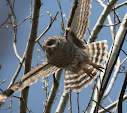
"I'm an Owl!"

"What???? Um....Why is the world spinning?"
Tough to see in these pictures, but there is something just above the bill in the first shot, and just to our right of the bird's left eye in the second. Not sure if that is an insect harassing the bird's ears or something else entirely, but that was quite a head shake.


My trip to Marshall Mesa was really about getting a fast loop in more than doing any intensive birding, but I did want to get back out as it had been a few days, and the weather is deteriorating. Beyond the head-banger it was a visit filled with Towhees and Chipping Sparrows. I had some Cowbirds in the pasture and Catbirds on the return, other than that it was fairly quiet.


The Sparrows and Towhees gave me a few good looks, and I did check the mesa overlook turnoff, which did not end up being the shortcut I had hoped it would but was a great view.

A good break, and more birding from last night and this morning to come.

Tuesday, April 7, 2009

A nice walk along Coal Creek


I was back out today for a lunchtime walk and got to see a few regulars and take a few pics. I haven't posted in a bit because work has been busy, other activities have won in the battle for my time, and when I have had time to get out the weather or light has been poor - but not today.


Here was a Mourning Dove perched close to the path. I noticed a bit of a white epaulet going on, not sure if that is an indication of some kind of hybrid, or just a few rearranged feathers on a breezy day.


As I was coming back I had a few Robins bathing in the creek. I counted 65 total on my walk, but the half dozen enjoying the water seemed to be enjoying themselves the most.


At least until I walked by and caused this one to hop up on the rocks and shoot me a serious stink eye.

Beware the headless Red-Tail Hawk!


Just preening - it is amazing that their necks do that. Owls get all the credit for spinning their heads, but this hawk was doing some real contortion to reach that itch.

Wednesday, March 18, 2009

Two Fun Surprises


"What do you mean I am not considered a fun surprise?"

Today I decided to try to head east on the Coal Creek Trail system, from the Coal Creek Golf Course where I found ample parking this winter. I quickly found that the trail did not run parallel to the course, but cut away from it, and through a neighborhood towards Dillon Rd. After one wrong turn, (the trail is only identified by a wider sidewalk through the neighborhood), I managed to wind my way through the neighborhood to the "trailhead" where it emerges on the east side.
The potential of this area made the detouring walk well worth it, as it has a great stretch of riparian habitat along the creek, and an open hillside which meets the flat fields that are found north of Dillon Rd. It is an area where I often see Red-tails roosting in trees surrounding a small private pond, and in fact I had spotted a single RT Hawk perched in the trees near that pond from the farthest extent of my detour.
With about five minutes before I needed to turn back I walked along the edge of the golf course to the creek where I saw the Robin above with almost 20 of her friends, and a pair of Black-billed Magpies. (Fine and dandy, but less than I was hoping for on what was going to exceed a two mile lunchtime walk).
Then I saw:


A pair of Red-tails circling towards me, one of whom was continuously trailing both legs below. I had not seen that behavior and will be doing some reading tonight to see if this is seasonal behavior. Do Red-tails clutch one another's talons when selecting mates? Is extended leg flight a precursor to such behavior? I will post an update if I find out.
UPDATE: I took a look at the National Audubon Society's The Sibley Guide to Bird Life & Behavior by David Allen Sibley, I found the following passage:
"Some flight displays are performed by a pair, as when Red-tailed Hawks circle together and chase off an intruder. After such a display, the male floats down to the female from above and behind, dangling his feet and white thighs. As he approaches, the female dangles her feet in the same way, and the pair parachutes a few inches apart in a stately descent to a perch near their nest." p 219.
I saw the pair rising while circling in a thermal, and the arrival of the eagle prevented any stately descent to a nets site, or the copulation which is said to follow. Perhaps it was just a bit of early courting. I should note that periodically both would dangle feet, but the one (male) was persistent, and the other (female) only dropped her feet occasionally.
Unfortunately the pair managed to evade being in a single frame while in focus, so you will just have to take it from me that it was worth watching. It was becoming clear that I was going to have to rush back on my return trip and that I really needed to leave, when out of nowhere:

A darker third party arrived. Compare that wing silhouette to the Red-tails in previous posts, the wings appear uniformly broad, and show long primary feathers at the tips. As I had been watching the Red-tails had been moving towards the sun from my position. So from my position below at the time it arrived the third bird appeared uniformly dark. It could have been either a Vulture or an Eagle based on wing structure.
Here is a closer crop of the bird as it announced itself to the Red-tails:


Note the size and shape of the head and beak. A Turkey Vulture has a small, featherless, head and a small beak designed to help it pull morsels of meat from carrion. This bird has a large head, and a large thick beak. It is an Eagle, likely a Golden rather than an immature Bald Eagle based on local observation patterns, and some worse focused pictures that grabbed a hint of color from the head.
The second surprise of the day was one that I would never have appreciated until I spent some time reading the Birdchick's Blog. She started keeping bees, and through her posts regarding her experiences I learned a great deal more than I could have imagined possible. (From my perspective honey is great, it comes in a bear shaped dispenser at the grocery store).

Anyway, as I walked back towards my car I spotted yet another sign of spring:


A beehive in a hollow tree. I don't think I would have been as quick to note the bees arriving at their hive if I had not read about their habits, and I never would have noticed anything special about the slightly larger yellow patches on her legs. Just knowing that the picture is of a female bee shows that I learned a lot.
Those yellow patches are pollen baskets, and are what the bees store the pollen that they gather from flowers in on their return flight to the hive.
That is one of the great things I love about nature, reading about a behavior or species, and then getting to see it in real life. In this case I had the immediate ah-ha moment of spotting a wild hive, and then a second, when I discovered the full pollen baskets when I was reviewing my pictures. Double bonus for me!

Tuesday, March 10, 2009

Big Dry Creek

The Big Dry Creek open space is a great resource that runs through Westminster and cuts across 120th Ave minutes from my home. Yesterday I took advantage of the later sunset to get in a good walk and see what birds were about. To start it was all Prairie Dogs and European Starlings.


The Prairie Dog is essential to good wildlife watching here in the high plains habitat. Their place on the menus of Coyotes, Hawks and Eagles make their communities great places to stake out predators. In addition their alert calls can give an early heads up if a raptor is soaring overhead and up-sun from a current position. I have read that their warning barks are threat specific, so in theory they could let you know what they are watching while you are in their area, but I have yet to see that applied by anyone.


While I was walking south towards the 120th underpass I got buzzed by this Sharpie (Sharp-shinned Hawk). He was on me so fast that I didn't get a well focused image, but this and the few others I got worked for identification. As usual with raptors I double checked my own impressions against Jerry Ligouri's, Hawks from Every Angle: How to Identify Raptors In Flight. Sharpies are a tough ID in the field for a relative novice like myself because they are very similar to the slightly larger Cooper's Hawk. Key identification points to look for are the squared off tail and smaller head. The Sharpie is generally more stout in appearance due to wing shape and a relatively short tail length. Also the Sharp-shinned Hawk has a body shape that starts broad at the shoulder and narrows towards the tail. The Cooper's Hawk tends to be more uniformly broad.

I half expected this guy to start dancing to "I'm Alright" as I walked past.


Shortly after the Sharpie I was treated to a very cool sight. There are two Northern Flickers in the picture above, see them both?


Here is another frame that shows the trailing bird more clearly. Not only was the lead bird a Yellow-shafted Northern Flicker, (my first sighting), but the two chased one another from tree to tree for the full ten minutes I was watching them. Their under-wing colors would flash in the sun on each upbeat and as they banked and dove around branches. Suh-weeet!

A handful of Cottontails are mixed in among the Prairie Dogs, although I think I see them in greater numbers in my neighborhood each morning.


As with my previous visit to the Big Dry Creek area the Robins were prolific. They still seem to be plotting, but don't seem to be taking any action yet......


...unless rerouting air traffic from Germany is a part of their plan. Muhhhhaaaaahhhhaaaa! It was a randomly low circling transatlantic jet for this area, but it did immediately precede the change in weather, that brought a cold strong wind from the northeast for the rest of my walk and snow overnight.


I'll leave off with this shot of one of the Prairie Dog predators. The Coyote and I surprised one another as I walked along a roadside to get a better view of a potential owl nest, and it was cruising into the Prairie Dog town from some cattail growth. I backed away to avoid unintentionally driving the hunter towards a busy road, and as I left the Coyote had withdrawn beneath some scrub. I was a bit disappointed to have not gotten a clear view of the nest from a higher angle, but was treated to three Red-tails circling and lightly hunting above me. Of course that was just as my one gb card filled up and just as I realised that I did not have the partially full four gb card that I had believed was in my pocket. Take my word they were great looking birds! I saw a total of six Red-tails, and believe that the three may have been a part of the beginning of migration.
2009 Count: 65
Lifetime: 93

Tuesday, March 3, 2009

Wow - What a Day!

Some days are so nice you feel like shaking off winter.


It really was a great day yesterday. If this is the March lamb impression for arrival I hate to see what the lion is going to look like on the way out..... It really feels like May, which is scary for Colorado. As March is typically the snowiest month, we are either going to be in for a long dry summer, or we are going to get used to this 70 degree business just in time for a 3 foot blizzard. I think the best plan is just to enjoy it while it lasts.


I took full advantage, I went on walks at four different locations on Monday. During my lunch I visited a great location in Louisville that is just a great little open mesa area with some wooded sections on the path I use to get there. It was great watching the Red-tails soaring at midday. I even met a woman out taking her Macaw for a walk. She excitedly told me about the soaring hawks up ahead as I wondered if that Macaw was enjoying the outing as much as she was. Would they make a hawk snack? Very cool sight though.


In the afternoon I stopped at Frank Varra park where I saw three Red-tails circling in the distance, and not much else. So I abandoned it quickly and headed on to two of the best Broomfield Reservoirs, Brunner and Plaster. Brunner featured the Robin above, some Common Mergansers and Scaup on the lake itself and of course the usual supply of Ringed-bills.

On the way out I caught this House Finch in the sun against a dreary looking background. Honestly the Gull and Finch positioned themselves to make the sky look awful, but the sun was shinning and really caught the finch's color.


Off to Plaster where the Red-winged Blackbirds and House Finches were using the mild weather to get down to the business of staking out territory and attracting mates. It was great accompaniment to the beautiful weather. I did have a mystery along the way, and one that I have not convinced myself of completely. Based on the light dark coloring and small overall size of the bird below I am leaning to a Dark-eyed Junco with a bad hair day, but I could be very wrong.


If I am showing my ignorance and have missed something blatant please feel free to let me know by email or in the comments.
I did also enjoy the Song Sparrows, some of whom were actively singing.


For those still enduring real winter, wish you were here!

Monday, February 2, 2009

Sun-Kissed Crowns


This is a catch-up post from the 29th of January. (I haven't been out since, so it seems like it was yesterday). Due to a work scheduling modification I ended up with a few surprise hours free Thursday afternoon. I decided to go bird a section of the Big Dry Creek open space that runs through Westminster just south of 120th.


It is an area that I have run and hiked in, but haven't really looked at as a birding possibility. I did find out quickly that my chosen parking was far from the most convenient, but it was a good afternoon for a walk anyway, and the greenbelt I followed to get to the open space did yield a dozen Mallards and a male American Kestrel.

The interesting part of the day was a comparison of two different White-crowned Sparrows. I saw them both about 20 minutes apart, one well above the creek in a reedy area bordering a soccer field. The other was down just along the creek itself, somewhat closer to sunset.


Above is sparrow #2, showing the field guide coloring clearly marking him a White-Crown. Below is sparrow #1, whose head looks much different, with only a few minutes difference in sun angle.


The difference also shows in the head-on views, below.


Sparrow 1.


Sparrow 2.

Enough of the sparrows. As I was checking the area I found that I had placed myself right in the midst of a flock of Robins. I easily counted over 200, and estimated the count around 300. Robins are interesting. First off as a kid in Minnesota I remember looking for the first Robin of spring, but here in Colorado they are year round residents, and apparently invite their northern neighbors down to "hang-out" for the cooler months.
I remember them as individuals, maybe you would see three or four, but rarely more than that. Must have been the seasonal difference, and flocking behavior for migration and wintering. On Thursday the Robins were everywhere, but loosely spread across the entire area I was walking in. Smaller groups would sometimes bunch more tightly, but individuals seemed willing to shift from group to group as they worked their way through the fields and bushes. It was some interesting behavior to observe, and as with everything seems to raise more questions than answers. The lesson I'll take away is that if one Robin is around chasing a worm there may be hundreds more nearby, lurking....., planning......, preparing to take over the world! Muh-ha-ha-ha-ha.


2009 Count: 56

Lifetime: 86