Showing posts with label Rock Wren. Show all posts

Monday, September 14, 2009

Fall Counting at Barr Lake State Park

I had the chance to spend a great Saturday helping out with the Fall Bird Count at Barr Lake State Park. The weather wasn't spectacular, overcast and damp, but birding with others is always educational. Saturday was no exception.


One of the early highlights of the day was the Osprey in the previous post. In addition to that I had the chance to observe four new species, three of which I got passable photos of, including the Swainson's Thrush above.

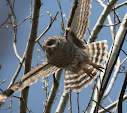
Not all birds were new, however, some just gave me better photo opportunities than I have had in the past. The Rock Wren above and Great Egret below were two such species. The Great Egret was a species that I observed for the first time in Colorado.


It was really a day of Egrets when looking out over the vegetation surrounding the lake. We kept passing groups of Snowy Egrets in numbers from four to six, and then near the end of the day saw a group of 20 all working through the weeds together. They made a good comparison with the Great Egrets who were far fewer in number.


I was glad for the accompaniment of a much more experienced birder, who was able to help me identify this Cassin's Vireo. The overall olive tinge is a strong field mark distinguishing it from the Plumbeous Vireo which is more gray.
The Vireo wasn't the only Cassin's species I observed however. The two Kingbirds below are of the Cassin's species. We saw these mixed in with several Westerns in a group of passed sunflowers. In the field it was tough to be certain of the id, but after zooming in on the stills the overall gray head and upper breast were clear. That differs from the Western variety which has a lighter head and white on the breast. Because of the lighter head on the Western Kingbird, it has a more distinct eyeline. In contrast the Cassin's has a less distinct eyeline, but a distinctive white malar streak. It was a good lesson to learn. Later as we visited with some banders working further along I learned that in mid September most of the Westerns will depart and Cassin's Kingbirds will become the more common of the two until they complete their migration as well.


Along with the Cassin's Vireo, Kingbird, and Swainson's Thrush I added a group of Franklin's Gulls to my list, but while distinct through a scope they were just blurry specs on a fully zoomed photograph.
Counts are great fun, and as always birding with others is a good educational experience. If you don't get the chance to join one this fall think about clearing some time for a Christmas Bird Count in a few months. I am really looking forward to repeating those counts and being more of a contributor this time around.

2009 Count: 185
Lifetime: 193

Tuesday, May 12, 2009

Doudy Draw - How Have I Missed This Place?

Here's an old friend from my Nebraska trip, now seen in Colorado

Back in the mid-Nineties, when I was an undergrad and a new arrival in Colorado, one of my favorite drives was south on Highway 93 along the foothills in the late afternoon or evening.
It still is - for all the same reasons. As you drive along, hogbacks and mesas break the view eastward towards the cities of the Front Range. The setting sun will peak between the rock outcroppings of the Flatirons and foothills, and make a natural splendor of light and shadow. In addition, for stretches of that fantastic hilly and curvy ribbon of asphalt you can lose sight of all development, and picture just for an instant how the untouched splendor of the Rockies must have appeared 200 years ago.
You could say I like the scenery a "bit". Knowing all that it is amazing to me that until last night I had never had the inclination or desire to visit the Doudy Draw trailhead. I have hiked, biked, and driven all around the area, but had never jumped on one of the trails heading along or towards the foothills west of 93. Now I know - insane!


Hummingbirds look like they never quite bought into the idea of feathers over scales.

Finally the idea of migrants and a known Boulder hotspot made me pull into the lot on the left side of the street rather than the right, and BLAMMO, there I was. A nice trail runs along the South Boulder Creek valley, and eventually climbs along the ridge to offer occasional peaks through at the Flatirons and foothills to the north and west. With just a bit of haze it was spectacular.

A House Wren and its mate appeared to be busy carrying nesting materials to the back of a nearby tree.
Word on some of the Colorado Birding email lists is that the changes to the trail configuration at Doudy Draw have made it less appealing, and frankly I can see why. More of the trail has been shifted up the hillside and away from some great riparian habitat. However, even seeing that the older trail which is now blocked off looked much more favorable I am willing to accept the area as is. I look at the hilly trail before reaching the ideal habitat as a buffer between the dedicated and those looking for an immediate reward. After all, part of what has attracted me to doing this so often is the chance to find peace and calm, and an active relationship with Nature that had been missing from my life. Walking ten paces from a parking lot to a overlook, or worse, shooting frames from my car window is a necessary compromise at times, but it really can't compete with a good walk on a beautiful summer afternoon.
But, then again I have only been birding a few months, and had never been to the site before, so what do I know?


This Rock Wren knew that its place was on a rock.

Even with a more distanced trail the birding was still fantastic. I had new species for my lifetime list, the House and Rock Wrens pictured above, a Catbird, Western Bluebird, Yellow-Breasted Chat and Clay-Colored Sparrow all pictured, just not well enough for here! That was not all though, oh no. There was a whole family of species that I had been waiting to see all winter, Orioles. I don't recall ever having noticed an Oriole in Colorado, and only once as a kid in Minnesota. Last fall though I learned that the little hanging balls of fishing line or fiber you see on trees can be Oriole nests. As I have walked and observed through many habitats this winter I have seen the nests everywhere, an known that at some point I must find one of those colorful birds at the back of the guide.
Yesterday was that day:

May I present, the Bullock's Oriole!

All of the color of a finch or warbler, none of the tiny size issues. It was great fun to find and watch these colorful individuals, there were two that I saw. They act quite shy and elusive, but their brilliant yellow-orange plumage isn't very conducive to hiding in the thin spring growth. A bit frustrating when taking pictures to not often see the face, but more bearable when the comic value of bits of orange poking beyond both sides of the same thin branch is realized.

Great color, great location, great afternoon.

It was a bit of a milestone day on the counting side of things. I broke through 150 on my global lifelist, reached 130 in Colorado, and broke 100 in my first county, Boulder. I have learned so much through these early months, and can't wait to see where I am when I reach the one year anniversary. That will hopefully be many productive months from now, after the end of spring migration, a whole summer, and then a fall migration to boot. Good times and continued improving photographs ahead!

2009 Count: 136

Lifetime: 151