Showing posts with label Western Kingbird. Show all posts

Thursday, September 9, 2010

Living with Danger


Whatever that little bug is, it decided to tempt fate a bit on Tuesday afternoon. Flying within inches of a perched Western Kingbird would seem to be a life expectancy limiting move on its part. So did the bug decide to high-tail it out of there, nope.....


It went in for a closer look. Gutsy, and for whatever reason that particular Western Kingbird was content to watch rather than reaching out for an easy snack.
Tuesday was particularly smokey, on that day the fire was still generating a billowing cloud of smoke. The inversion had lifted shortly before, and as I stopped by Singletree Trail the fire bombers began a constant rotation overhead. The day offered a great collection of kingbirds, mostly in the form of a group of Eastern Kingbirds, which seemed to have flocked for migration. Just watching them repeat their aerobatics again and again was a boost for the day, but on my way back I had another surprise.


A tiny bird popped out of the undergrowth at my feet. I sent the following to the COBirds mailing list, because after checking my resources I wasn't sure if a Winter Wren should be expected in Colorado at this time of year:

"...if anyone could advise me on whether a Winter Wren has any degree of likelihood in Colorado in the first week of September, I would appreciate it. This afternoon at apx. 2:30 pm I was walking along the Singletree trail just SW of old Superior. From the trailhead heading west there is a good stretch of heavy brush on the right (north) side, then an old tailing hill, and immediately to the west a group of large cottonwoods. I was directly under those trees shooting photos of some Towhees and Doves out in the distance when I heard a rustling in the low groundcover at my feet. My impression was 100% mouse - it was making small moves out of sight, in thick vegetation 4-6 inches high, but its progress could be perceived as it moved around. I was completely surprised when a tiny Wren popped out almost at my feet. I didn't even attempt a photo, my lens was extended and focused way beyond something that close, and motion would have sent it back to cover even faster. I had 2-3 long seconds as it turned at my feet. My impression was an overall chocolate brown bird, with very limited markings. It gave a couple of short, exposed hopping moves at my feet, flew a short distance to the fallen trunk, and then dove to the larger shrubs beyond. It did not reemerge, and I did not pick up any notes or calls, (but fire bombers are flying directly over the site repeatedly this afternoon). There is a dried creekbed to the north, but I am not aware of any open water near the site. "

I did return to the site that evening and the following morning, but never heard a call, or saw the bird again. I did receive several responses confirming that Winter Wrens were seen in Colorado in Sepetmeber, and that the species fit the description. I had hoped to get a chance to photograph that bird to share, but guess I will have to continue to watch for it. Instead, how about a pair of Eastern Kingbirds?


Finally a recognition out to all the firefighting resources that are working on the Four Mile Canyon fire outside Boulder. The fire has made the national news cycles, so the details are well known, but despite remaining stationary through a pair of calm days the weather is supposed to turn dry, clear and windy - and so the situation may be about to get worse. So far the Betasso Preserve has been just outside the burn area, to the SE, and based on the reports that is the area where some degree of containment has been achieved. However the forecast wind is supposed to be coming in out of the N - NW, so it could be gone quickly. Any direction the fire moves will be bad though, and this is already being called the worst fire in Colorado's history.


I guess in life we are all a bit like the bug. The residents in the foothills of Boulder County trade an ever present risk of fire for the chance to build a home in truly beautiful country. Some, like the bug may luck out and find that the fire has spared their homes by mere inches, while others will have lost everything and have to start anew. Fortunately, all that has been lost so far is replaceable - lets hope that all those working in and around the fire zone remain safe and keep it that way.

2010 Count: 197
Lifetime: 242

Tuesday, June 8, 2010

Friday June Fourth Recap - Orioles

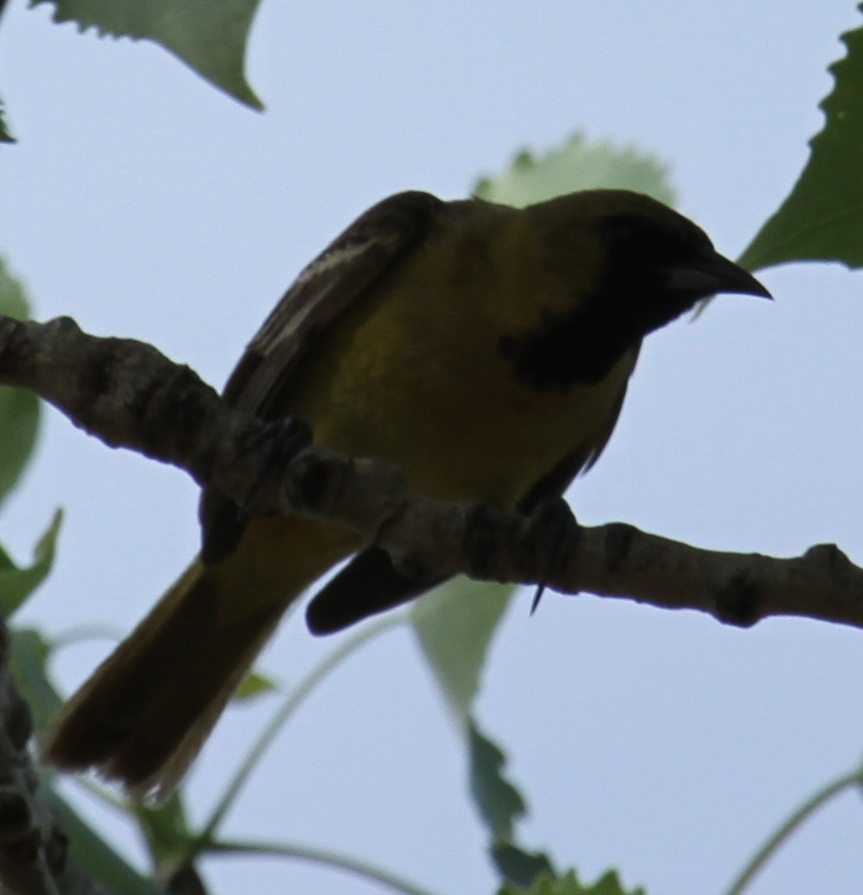
As I headed east on Friday I was looking to pick up a couple of eastern birds that I have seen regularly on trips to the Midwest and beyond, but not yet in Colorado. Specifically I was hoping to pick up the Northern Cardinal and Red-belied Woodpecker for my Colorado list. I didn't get either of those two, but did pick up two eastern species of Oriole on the trip, both of which were life birds for me since starting to keep a list. As dawn broke over Sedgwick Bar I was getting frustrated as I heard, but couldn't see, Wild Turkeys and Ring-necked Pheasants in the hedgerows around me. Then I caught a glimpse of color in the treetops beyond me - a Baltimore Oriole with color to rival the sky.


Check the bright orange color on the underside of the tail. That is a tell-tale indicator for the Baltimore Oriole. I had to double check that one, because later in the morning when I stopped at the picnic grounds at Jumbo Reservoir I had the pleasure of seeing a large group of Orchard Orioles widely scattered with the Western Kingbirds throughout the trees.

Both species have dark heads, with the most prominent difference being the more red-orange color of the Orchard Oriole. However, since I had seen the brilliant orange of the Baltimore at sunrise, and was watching the darker orange Orchards in the broken shade of the grove of trees I wanted some other field mark to make sure I had both species and wasn't just trying to make one species into two. The clincher was the underside of the tail. On the Baltimore, the already mentioned orange is visible, but the Orchard Oriole's tail is all black. That makes the tail a good reference point when lighting and time of day make comparing the two species by color more difficult. Another difference between the two is size, with the Orchard averaging smaller than the Baltimore Oriole. I did get a feel for the smaller size of the Orchard Oriole while I was in the field, and before I had consulted the guide back at my truck. I even had one pose close to a Western Kingbird for a comparison shot.


As I was leaving I got an unexpected look at a juvenile Orchard Oriole. I was surprised that the yellow bird with a black throat would turn into a chestnut bird with a black head, but then if a bright orange fuzzball can turn into a sleek black American Coot I guess nothing is really that surprising.


The Orioles alone would have made my stop at the picnic area memorable, but I had one more treat in store before I left that little grove...

Friday, May 28, 2010

The Return of the King...

The Western Kingbird of course.


Yesterday morning I got a bit of an early start, just enough time to stop off at Stearn's Lake on my way to work. The one above was actually seen in the afternoon at lunch, but they were certainly back, and engaged in all kinds of territorial and pre-nesting activities.

The award for the most photogenic birds of the morning has to go to the Vesper Sparrows I saw as I left the lake area and headed to work. They put my shots of the morning Kingbirds to shame.


Birds like these are the reason I always leave any morning birding stops with a large cushion of time before I have to be to work. You never know when you will have to stop and shoot a hundred frames or so.


A Vesper Sparrow has plenty to sing about on a late spring morning. I was glad to hear their song, a good way to start the day.


I wonder if the cow hair left on the barbs from a good scratching is alluring to a female Vesper Sparrow? This bird sure was advertising it to the world.

Friday, July 31, 2009

Larking About - Sparrow Style!


After work yesterday the clouds began to break up a bit. To be fair my office is close to the foothills and got rain and heavy overcast all day - I think just a bit east the weather was much nicer all day. Yet another cool thing about close proximity to mountains, micro climates and ever changing weather!
Anyway, I took a drive back to the moose area in Broomfield, still no luck but I wasn't expecting any at that point. Instead I headed to an undeveloped area with park access near the Northwest Parkway. I took a walk through some semi developed acreage. It is a weird bit of land where apparently the housing boom planned a neighborhood, and now hasn't built any homes, leaving an area that had been graded and "improved" to sit idle for a few years.
Thanks to the rain there was a heavy flow through a drainage ditch stream, and some oddly overdeveloped underpasses and walkways that don't connect to anything. Weeds are already beginning to break concrete, and fancy lightposts have shifted off vertical. Leaving me to find these oddities and wonder, and hope, that they can remain known to the just the handful of folks who get off the beaten track for even a few years more.
Another Swainson's Hawk (above) was there to keep an eye on me. The sun broke through to catch it, with the still lingering dark thunderheads for a backdrop.

While I walked I was treated to constant entertainment by what I believe to have been a group of 4-6 young Western Kingbirds. They seemed to be practicing flight displays and territory disputes, and would go all out for a few seconds. Then in a blink they would settle down together to preen or relax, sometimes all sharing the same branch. I found a convenient rock to keep the seat of my pants clean and watched for a few minutes. It was a great level of activity for relaxing, they would call - much like prairie dogs, and perform their displays. I have often seen solo kingbirds hawking insects, but to see so many all engaged in a variety of activities was a real show. It is what made me think that they were a group of youngsters, likely with a few adults showing them the ropes, who were learning and practicing the skills that they will need to thrive throughout their lives. Very engaging.


Soon I was on my way though, and glad that I was. Had I stayed watching the kingbirds I would have missed out one of the more colorful sparrows around - the Lark Sparrow.


I had to do a bit of work to get past it, and then return along the trail with the sun coming from behind. Even so it was fairly tolerant of my approach. I wish my focusing had done the contrast in that face justice. A species that I am glad to have enjoyed in the field, and one that will make a return visit to that particular bit of wasteland a priority for me.
2009 Count: 171
Lifetime: 181

Thursday, July 23, 2009

Barr Lake State Park

On my quick visit to Barr Lake State Park on Sunday I was treated to a few moments of great light, and a whole lot of looks at Western Kingbirds.


There was a good sized group around the Visitor Center, who seemed more concerned with a nearing storm than my presence in the area. Even the two young ones didn't seem concerned. There was a Cowbird in the area that also appeared young, and seemed suspiciously like one who was just realizing that there were some major differences in the members of the brood.


I wonder if there is an awkward moment when every Brown-headed Cowbird slinks away from the nest and brood, much like Carl Spackler in Caddyshack after the priest was just struck by lightening. I didn't stick around to find out, because in addition to lots of Western Kingbirds there were lots of mosquitoes and they were some kind of mutants that were completely unfazed by my spray. So I was off to the car and have been busy scratching ever since.

Monday, June 1, 2009

Coot Lake and a bit of Boulder Reservoir


Friday evening I headed north through Boulder, thinking that I may stop by the Walden Ponds - Sawhill Ponds Complex to see what all was in the area. Due to being on a different road than I realized I was actually further east than I had planned and missed my turn. So instead of fighting traffic and guessing on backroads I continued on up to Coot Lake, just north of Boulder Reservoir.
In addition to many dozens of Red-winged Blackbirds, a few Western Meadowlarks, and six colorful spinning parachutists I got to see an photograph 8 Eastern Kingbirds. Since I wasn't looking for this species I got to try to categorise it based on observations while I was taking pictures. They were actively hunting insects, and let me get very close while they did so. I could watch as they waited, launched, and then made an aerobatic attack before returning to their preferred perch. I had a "duh" moment when I compared my pictures to the guides, and the pictures I had of two Western Kingbirds that were in the same area, behaving in a similar manner.


The colors of the Western are eye catching, but the contrast of black and white on the Eastern, along with that brilliant white tip of the tail make it equally pleasing to watch in the field. These two are definitely favorites.


The picture above was a great surprise. It is a Cliff Swallow that was hunting over the mudflats at the outlet of Boulder Res. I was getting ID shots of some Spotted Sandpipers and Killdeer on the far side, and took a few frames of the swallows as well. I had basically dismissed them in my fascination with the bee in the previous post, (I saw it minutes later). So when I was flipping through this morning and saw this swallow in flight, with it's eye frozen, looking at me as if to say, "Whats the big deal?" I was just blown away. Sometimes it is better to be lucky than good!


Just after the random Cliff Swallow, and the European Honeybee, I saw these two Tree Swallows. Their impending activities were a fitting site for someone photographing both birds and bees on this day. I left the happy couple to themselves and finished my walk in time to head for home and catch the end of the Nuggets playoff chase. One less distraction now from the wonderful world of nature and summertime pursuits.


To close, here is a Goldfinch that was in the grass just off the trail. It sat while I took shots as a woman approached walking her dog. I anticipated that it would take off, giving me a chance for a flight shot, but it never did as she approached, only later as we talked did it head for a more distant treetop perch.
2009 Count: 151
Lifetime: 164

Monday, May 4, 2009

Western Kingbird


Another lifer while on lunch today. What a cool looking bird! I have pics and posts ready to load from the trip and Friday, but a picture upload issue has kept me waiting since late yesterday. For now though I am getting outside while the getting is good!
2009 Count: 123
Lifetime: 139