Showing posts with label Northern Harrier. Show all posts

Sunday, September 25, 2011

Stearn's Lake Saturday Morning


I was out before the sun on Saturday morning, and took the opportunity to visit Stearn's Lake at the southern edge of Boulder county. Readers of this blog will know that this was a spot I visited frequently when my office was located in Louisville and it was a brief turn from my daily drive. On my visit Saturday I stood in the company of a pair of Bald Eagles waiting for the sun to clear a ridge. Turning to the east, a distant post caught my eye...


My interest was peaked, and I did some backtracking to try an approach from another direction. My effort was rewarded, my route took me out of view of the post, and when I had reached a new vantage point it was bare.


To my delight, the bird had relocated to the small tree that had been blocking my view, and had multiplied! I took a few shots, and then dragged myself away to let them settle in for the day.


I looped out to the south, and returned along the edge of a pumpkin field, (they're getting close), as I walked I had some Vesper Sparrows to keep me company, showing off their seasonal colors in the post-dawn light. As I walked I was teased with unphotographed views of at least one Cooper's Hawk. I never got a satisfactory shot of it (them), but did get a nice distant shot of a Northern Harrier skimming the cattails on the far side of the lake. They are so distinctive when seen hunting mere feet above a marsh or field, the white rump, and facial disk were both visible in this shot.


I checked on the owls as I returned to the parking are from a distance and they were still visible. I'll take the opportunity to post one more of their previous shots, they were a real highlight to an enjoyable weekend start.


I hope that yours was just as beautiful, wherever you found yourself yesterday.

Wednesday, October 27, 2010

Morning Walk


This morning was crisp, but the wind had died down (mostly), so I stopped by Stearn's Lake for a pre-work walk. The Northern Harrier was already hard at work patrolling the fields for rodents.


A Ring-billed Gull was cheating a bit, it flew up to get an early sunrise.


Northern Shovelers were doing their thing as well. I believe the two are young males, with an adult male just visible behind and to the right.


Last but not least, one of a group of Song Sparrows popped up on a fence as I headed back to the parking lot. The birds of the season have arrived, but the weather is still mild. Seems like a drive to the mountains is due for this weekend.

Thursday, May 27, 2010

Birds of Wyoming's Hutton Lakes NWR

I had three great field trips while birding at the Colorado Field Ornithologists convention last weekend. All three had different feels to them and exposed me to three different habitat types on the trip. The first was the Red Feather Lakes trip, which ended up being a good tour of the foothills habitat, roughly covering the forest range from plains up to treeline. The second trip was to the Phantom Canyon TNC property, which was beautiful, but didn't lend itself well to photography. My final trip was actually designed to be a photographer's trip. Just over a dozen of us loaded up our dSLRs and Digi-scoping rigs, and headed north for Wyoming to see what the gale forced winds would blow in. We weren't disappointed, I shot these Wilson's Phalarope, firsts for 2010, from my vehicle before even reaching the NWR.


A trip of birding photographers is the best, everyone understands that shooting through the car and past a passenger's head is perfectly acceptable when the bird is on the other side of the road. The favor was returned back and forth multiple times. My next life bird, also seen before we had reached the NWR proper, was a McCown's Longspur, this time posing on my side of the vehicle.


Our first stop inside the refuge was behind the brush where we had all staked out the Marsh Wrens. As we enjoyed our sheltered spot we were also treated to occasional flyovers, such as this Forster's Tern.


We weren't the only ones seeking shelter. As we drove between two lakes we had a nice look at a Willet, which had abandoned the water for the relative calm of some scrub brush.


We also saw it's evil twin, the less well known 'horned willet'. Right, same bird, but the wind did lend itself to lame jokes.


The birds were all doing their best to cope with the strong winds, but some species are just designed to thrive in such conditions. The Northern Harrier, a species that normally glides effortlessly over fields and marshlands anyway, was able to fully extend and use every gust to scrutinize the flooded cattail beds.


We humans, on the other hand, were not so well adapted. We gathered our tied down hats and wind battered senses, and headed south for the border and calmer air to enjoy our lunch. One more impromptu stop awaited, and one more life bird for myself, but that will show up in a final post.
Photography, like birding, is one of those hobbies that lends itself to the quiet contemplation of nature. I find that through scheduling and the opportunistic style of most of my birding that I am generally alone when I pursue both activities. So, it is refreshing to get out with a bunch of folks who enjoy combining the two as much as I do. As great as group birding is, it can often be detrimental to those of us who are always looking for the next good shot. Birding courtesy dictates that a photographer allow the group to get good bins on the bird before pointing a long lens at the target and firing away. It was rewarding to be with others who were also seeking the shot as a goal. If you know other bird photographers in your area you may want to set up a designated bird/photo trip of your own. I am not going to say that this one took me from being an average photographer to an expert, but I definitely came away with some new insights and techniques to try.

Monday, February 8, 2010

On the track of a Red-shouldered Rarity


Saturday along the Front Range in Colorado was overcast and chilly, but not wet, so a good chance to go after a few of the rarities that had been reported in the area but which I had not yet successfully located. I started the day in Broomfield, looking at gulls, but those are a story for a later post. For the moment I am going to jump ahead, and North, to Weld County. I headed there in hopes of seeing the immature Red-shouldered Hawk, which has been wintering out of range at the Kodak Watchable Wildlife Area. On the way I exited the Interstate a few miles south and swung into the Elwell Cemetery outside Johnstown to check the evergreens. It wasn't a wasted stop, seeing a Great Horned Owl sleep peacefully was well worth it.
Eventually, I did reach the outskirts of Windsor and the Kodak Watchable Wildlife Area. I have been reading reports about this bird for several months now, and on one previous rushed attempt had failed to locate it. This time I was committed though. I had no deadlines to meet, and having visited once before was able to process the descriptions of the birds habits better against the landscape. I heard it before I spotted it, and true to its description, my first glimpse of this easily spooked bird was as it settled into a tree on the south side of the river.

Shooting into the sun through a heavy overcast yielded poor results, but note the high degree of white in the back. That alone wouldn't have sealed the ID, even with my impression of the short single note call that was higher and shorter than that of a Red-tail. But this next shot captured a tell-tale field-mark in an otherwise trashable shot. That buffy patch towards the tip of the wing is a distinctive field-mark for a juvenile Eastern Red-shouldered Hawk. Knowing that the same bird was the one I was looking for helped as well, but I was still happy to find the bird and capture a conclusive - if poor quality - shot.


The Red-shouldered Hawk wasn't the only bird around by any means. A group of 20 Western Meadowlarks were singing in the scrubby trees surrounding a marshy area. Their song, the first I had heard this year, attracted the attention of a Northern Harrier, which was making low slow passes around the area.


Finally, as I returned to the parking lot I noticed a group of large birds in a distant Cottonwood tree. The group of Bald Eagles illustrates the difference between adults and 2nd (possibly one 3rd) year birds. Note how the juvenile looks a lot like a super-sized Swainson's Hawk with the dark bib on a light body? The bird on the left has its back turned and shows the small light triangle across the shoulders and upper back. Again, not the best picture, but one that shows them in the distance against a gray background, much as they often appear when driving along a highway at high speed.


Another post to follow that shows my gull filled visit to some ponds in Broomfield.
2010 Count: 58
Lifetime: 205

Tuesday, May 5, 2009

Trip Day 2: Crow Valley and Agate Fossil Beds National Monument


What trip would be complete without an Great Horned Owl sighting. This fine lady was nesting just outside the Crow Valley camping area, and was one of the first birds I saw that morning.

Kestrels are always fun to photograph. They have such great colors and are often easily seen an prominent perches. There were several around, and the rising sun really highlighted their colors.

I left the Pawnee National Grasslands and headed straight north along the western edge of Nebraska. My next destination was the Agate Fossil Beds National Monument. Before I arrived I had a chance to enjoy some truly beautiful rolling country. Herds of Antelope were abundant, and the limestone hilltops that occasionally punched through the shortgrass kept the scenery interesting. It is some of my favorite driving country.
(a bit non-birdy below feel free to skip to the next photo if you are a die-hard bird only type)
I arrived at AFBNM and had the place to myself. I don't know that there are many crowds to deal with even at the height of tourist season, but this is a place that can really be savored solo. I checked out the museum first, which is split between a display of the fossilized remains of mammals who lived in the area 19-20 million years ago, and Native American Relics gathered by the rancher who owned the land and befriended residents of the Pine Ridge Reservation in South Dakota in the late 19th century.
I was in heaven. I graduated with a Bachelors in history, and took a year of Geology as an elective just because I find it interesting. Even though I have forgotten a good deal of my geology coursework (its been close to 15 years) I am well grounded to appreciate the sedimentation and erosion cycles that created the area of the monument.
So 20 million years ago the Great Plains resembled the African Serengeti, cycles alternated between rain and drought, and large mammal ancestors of the large species we know today lived in the area. The monument has been developed around several dig sites that were discovered in the early 20th century. They formed at waterholes, where animals became concentrated around shrinking mudholes in periods of drought. As happens today in Africa some animals ultimately perish, and provide a sampling of all age and species groups in fairly close proximity. This site is unique in that several times these drought death scenes were immediately followed by remote volcanic eruptions, in at least one of the cases the ash deposits point to a volcano on the Idaho border. The ash buried the remains and allowed them to rest undisturbed for all these millions of years.
During that time the Rocky Mountains rose, and the erosion that followed caused the landscape to change from a large flat plain to the deep valleys and rolling hills seen today. A muddy sinkhole became a rocky highpoint and further erosion of that hill revealed the fossilized skeletons to the residents over one hundred years ago.
I didn't get as much of the Native American experience as the museum was going to be undergoing renovations, and I wanted to get back outside to the 80 degree sunshine, but I did buy a copy of the biography of the rancher and will enjoy getting a feel for his connection to both the traders and scouts of the mid 19th century whom I have studied closely in the area of the Bent's operations in southeastern Colorado, and his connection to the Lakota with whom I worked in high school in South Dakota.

On to my time outdoors:

The trail to University and Carnegie Hills crosses the Niobarra River several hundred yards from the Visitor Center. Here I was just miles from its headwaters in eastern Wyoming, but due to the previous week's precipitation it was in full flood mode and looked quite impressive. I saw several common birds, and startled both a White Tailed-Deer and what I believe was a Mink as I approached the thicker vegetation near the true creek bank.
Sometimes birds can be flat-out tough to spot, and this before the leaves have filled in. The shot above shows how well they can hide just by placing a branch between themselves and the perceived threat. That White-Crowned Sparrow had me frustrated with brief looks and cluttered foregrounds for a bit, but eventually patience paid off.


Nice.
A bit more text to wrap up a great Thursday. Walking up the hill to the dig sites at the top of the two hills was like a mini version of a day hike above treeline in the mountains. There were patchy clouds and a stiff breeze, and standing between the two hilltops channeled all of the moving air right through. Just me, the Meadowlarks, Harriers, and insects, and an impossibly gorgeous moment in nature.
Back at the visitor center I thanked the ranger geologist and he recommended the Toadstool Geologic Park if I had time. I was finding the travel times less than I had allowed for, without even pushing the speed limits, so I decided to head on up. He did caution that the road in and out was subject to flash flooding. I drove on up on the worst of the roads I encountered on my trip. It was still soft, and required vigilance to keep from hitting some unexpectedly deep potholes. My "off-road ready" Accord two door made it in style though, and I arrived to see the gathering thunderheads just clearing the ridge. I had though that camping there might be a possibility, but clearly the weather was not going to cooperate. I completed the one mile loop in about twelve minutes, (I left the camera in the car - a reason to return some other day).
I then raced the thunderstorm southeast to Chadron, where I had planned to camp in the Pine Ridge National Forest. Being that it was a ridge, covered with trees, and that I don't make a habit of setting up camp in rain or thunderstorms anyway, I made an audible to drive on ahead to Valentine, Nebraska and check into my hotel there a day before my reservation. The storm and I were neck and neck halfway across Nebraska, and I was certainly glad to have a roof over my head as the weather was a-changin'.

Trip catch-up: Pawnee's Buttes


I waited out a passing thunderstorm before hiking through the open trails around the Twin Buttes in the Pawnee National Grassland. It was fairly late on a Wednesday and due to the weather I had the place to myself. It really worked out well though, as the storm passed the skies cleared and I enjoyed a beautiful late afternoon and evening.


There were a couple of Northern Harriers hunting over the prairie. The white spot at the base of the tail is visible from long range and makes them an easy ID.

This Meadowlark was perched and enjoying the weather as well. It must seem even more enjoyable when you have narrowly avoided something having you for dinner. [Note the lack of tail feathers]


Unexpected rugged beauty in the midst of endless, rolling shortgrass prairie makes visits to this area so worth it.


On the way back to Crow Valley where I would camp for the night I headed towards Murphy's Pasture to catch some of the activity around sunset. Amidst the Horned Larks and Sparrows I saw this Meadowlark getting dinner before dark.
I was then off to set my own camp and eat dinner in the dark, before a refreshing evening under a meteor shower in the Prairie Skies.
This terrific resource was just over an hour from my work and will definitely be a site for future day and one-night camping trips.

Tuesday, January 13, 2009

Posing Female Juvenile Northern Harrier (Not Red-Tail)


On my lunch today I ran out to get my Boulder County Mountain Parks and Open Space parking permit. $15 will be worth 5 trips to Flagstaff Mountain and Gregory Canyon in the course of the year, and should have itself paid for soon.

The administration building is located close to Baseline Reservoir and the East Boulder Park Ponds. There is a trail that runs along South Boulder Creek next to the parking area, and I decided to check it out quickly with the time that remained for my lunch. I crossed a footbridge over the creek and was disappointed that nothing had been drawn to the moving water that had broken through the ice in a few places.

I checked my time and looped around the far side of the creek when I caught alarge bird flying low over a nearby field. She settled in on a post a few hundred feet from me, and I was able to move up slowly and get some fairly good shots of her.

She is, upon further review a juvenile Northern Harrier female, the white facial disk line is the giveaway trait. (Before editing I had this incorrectly ID'd as a juvenile red-tail and wondered about the facial disk.)
Popping up to land on the post.
Showing her dark banded tail, the "red-tail" is not visible until adulthood. After checking Hawks From Every Angle, I saw my mistake, the juvenile red-tail banding is fine, where these bands are broad. Again the facial disk was the key, but this is another telltale trait.
Light brown streaking beneath. Update, I should have noted that the streaking on a juvenile red-tail is faint, and would be limited to the bellyband area.

Just after landing. This pose shows his fluffed belly feathers, and those powerful looking talons.

If anyone does have additional details on the facial disk shown here please feel free to drop me a comment. (Duh, I saw it, but since I was so much closer than my previous Harrier sightings I hadn't appreciated their size. Lesson learned.)

2009 count: 46

Lifetime: 84

Saturday, January 3, 2009

Snow?

Will yesterday's Snow Goose be an omen? There are supposed to be passing bands of snow showers, but while the clouds have locked in there have only been flurries.

This morning I headed back over to Eastlake Reservoir, where I had happened to see the Kestrel on the first. I walked the full loop, picking up Robins, Mourning Doves, and a few House Finches for the year count. Eastlake features a nice rock wall observation platform for their waterfowl, but unfortunately it was not well situated for the open water left from the ice. As I looked through the group of Ring-bills for a stray gull I caught a raptor coming in across the lake. At the time I noted his rufous body, and wondered if it was the poor light on the resident Kestrel. I snapped a series of him crossing the lake, and then changed my focus to the gulls settling back to the ice rim once the danger had passed. Back at home I used my copy of Hawks From Every Angle, by Jerry Liguori to nail the ID. The dark hood, with a visible pale facial disk, uniform light rufous underparts, white rump patch and other details helped me narrow down the options to a juvenile Northern Harrier, lifetime checklist #82.
There was an entertaining scene as three loud Canadian Geese circled in and landed just in front of me. I think they may have had an argument about the directions they were following, or that the leader had landed them on an ice covered lake. Whatever the reason, the three had at it on the ice with much hissing and "goosing". It is comical to see a goose lose his feet and do a sliding 360 on his back. Unfortunately that bit evaded my camera.
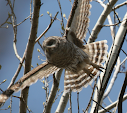


After my circuit I headed for home, on the way I spotted a hawk perched low off an intersection where I had seen a light morph Red-tail juvenile on the first. I pulled off at the next cross street and looped back on foot. While snapping pictures of what I believe to be the same individual, (top of page), I caught a few light colored doves sitting on a power line a few feet from the hawk. I shot five frames of these brave birds before wrapping up on the hawk. On closer examination these doves were Eurasian Collared-Doves, a species that has been exploding in numbers, but had eluded me until today.

2009 Count: 31

Lifetime: 83