Monday, July 13, 2009

Did I just see what I thought I saw?

Well, yes, I did see Dragonflies [update 6/2/2011 thanks to Dave Leatherman for pointing out that this is a Damselfly, not a Dragonfly, specifically an American Rubyspot] on Thursday evening, but that isn't really what had me thinking while I walked in the late day sunshine.


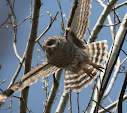
I had stopped to revisit a section of the Coal Creek Trail system rather than sit in traffic at rush hour. While I was walking I received a phone call and was busy talking when something big flew up into a tree from a quiet bend in the creek. With a "I just saw a really cool bird, I'll call you back..." I hung up and started shooting what I could see in the overhead branches.

Seeing the image now and knowing what I do the species is clear, but without the advantage of a full frame and just the size, shape, stripes and a hint of orange I immediately thought I was on to one of the birds I have been keeping an eye out for. A Bittern!
I got about 15 frames before the bird decided that even its treetop perch was too close, and flew off along the trail, in the general direction of the parking area where I had started.
After having inadvertently startled the bird I decided to give it a rest, continue on in the direction I was headed, and try to relocate it before I left.


As I walked I kept thinking, did Bitterns really roost in trees? From what I have seen of them online they frequent grassy wetlands where their stripes give them great camouflage. I held some guarded optimism for the sighting as I returned near the end of my walk. As I got close I kept an eye out, alternating looks between the creek itself and the canopy above. Before long I saw another large bird rise from the limbs, about the same size, but immediately recognizable in adult plumage. A Black-Crowned Night Heron. I held out hope for a few seconds that it might have been a coincidence, that perhaps they were both just in the same area. Sure enough though, seconds later the same bird with the brownish striped markings flew off as well. the two made on brief landing farther down stream, but were off again due to a passing car and soon out of sight.
So instead of a first American Bittern I had my first juvenile Black-Crowned Night Heron - and really that was just as good. Between that and the dragonflies it sure beat sitting in traffic.

Saturday, July 11, 2009

Spectacular Sunrise

Guess where I started my day on Friday!


Here's another clue.


I'll have more pictures from one of my favorite visits to this popular destination coming soon....there are a lot of pictures to sort through.

Tuesday, July 7, 2009

Begin the Day with Birds!

What better way to motivate for a workday than at a lake, at sunrise, surrounded by the textures and colors of birds?


Mourning Doves are common, but the low sun shadows make the spots on this one's back merge into the layers of texture. Even the mundane can provide beauty.


A Song Sparrow's song is just right to clear the mind and rejuvenate the soul.


This young Bullock's Oriole explores all the ways a barbed wire fence is like a jungle gym. Even prickly situations can be fun.


The subdued colors and contemplative nature of this Double-Crested Cormorant offer a reminder, that reflection and patience have their places in daily life.


Then an American Goldfinch finds a perch under cool green leaves and before a crystal clear blue sky. Make the most of conditions that favor your best qualities!
Finally, never be content with the way things are. The familiar may not be the best, be open to change if it brings an improvement! (Check out the new and improved Great Blue Heron header!)

No Mercy

Caution! The following post is a bit of a downer, no graphic images, but some of the tough realities of nature are explored. If you prefer a less challenging, more warm and fuzzy experience please stop reading - click here for flowers and bunnies, or wait for the typical bird pics from the walk post that will follow.


This guy or gal almost wrecked my mood today. The sun had only been up ten to fifteen minutes, and I was walking back from the east side of the large lake, (typically mudflat), when I saw a lone Canada Goose swimming towards me. It was riding low in the water, visibly struggling to reach the bank. I couldn't tell if it had a wing or foot problem, or if it was something else. In any case it was clear that if it didn't get resolved shortly the goose would not be long for this world. Granted, that part of the situation is a bummer, but it is a part of the way the natural world works. I have watched enough predators devouring perfectly healthy prey that the sight of a doomed injured animal at the very least doesn't make bloggable material.


What did was the response of three other geese to its desperate calls as it neared the bank. It had been using its wings to keep itself above water and looked and sounded exhausted. Then, one of the three geese in the area started honking loudly. It placed itself between the distressed goose and the shore and began to defend the territory.


It drove that individual away from the bank, and back out into deeper water. I walked away with plenty of thoughts to chew on - I didn't need to stand around and watch what I can imagine was the eventual outcome.
The question is, do geese drive away all injured or otherwise distressed members of their species? Having volunteered in a raptor rehabilitation clinic, and read examples on the web, I know that there are many bird individuals that cope with injuries, malformities, and other maladies and get on quite well. Since Canada Geese are frequently seen in large groups I have to imagine that the defensive response was specific to that bird, and not something that would have been presented to a healthy individual, but I could be wrong there.
That lead me to a next question, are there certain disease conditions amongst birds that can be recognized, and cause banishment - like leprosy?
Fortunately there were many other sights to see this morning, and the thoughts of rejection and death were chased away by bright sunlight and birdsong. Even so, I am curious if anyone else has encountered this or similar behavior. Any experts out there that can offer any insight are welcome to comment or email me.

Cottonwood Marsh and Walden Ponds - non bird


I love getting up before sunrise and starting the day outdoors! I also love staying up late, being with friends and all kinds of non-nature activities, so the early start mornings are few and far between. When they do happen though, they are almost always worth the horrible wake up time.

Of course the main intent of my walk was to see some birds, but wildflowers and mammals made their bids to steal the show. I have no idea what the bloom above is, there were a handful of them growing along the boardwalk in the now flooded Cottonwood Marsh.


Same goes for these purple jobs, but the sunlight catching on the tiny drops of dew makes them look impressive.

Not that this furball stopped to notice, the dew just makes them that much juicier.


Clear blue sky and bright colors make a great start to any day! The ladybug and gnat may not have appreciated the setting, but I sure did.

Monday, July 6, 2009

A flycatcher I could identify (I believe)


For all the United States based readers, I hope you had a good holiday. I had a short week in the office and ended up taking some time away from cameras, birds, and the outdoors in general. It was great. Today I headed out for an early lunch, and ended up with a newly identified life bird as a result. I headed down to the Bobolink Trailhead in Boulder to get a short walk in the shade before it got too hot. As I walked I stopped to get a few frames of a flycatcher. It was high on a dead limb, and as I shot I expected that it would be yet another dismissed as unidentifiable - it wasn't vocalizing so I didn't even have that option. However, when I got back and took my obligatory closer look I found that this flycatcher was different from the others I have puzzled over, it didn't have an eyering. After identifying that the Willow Flycatcher matched this description I compared the other field marks I could see and strengthened my confidence in the ID based on the many large willows in the riparian habitat along the creek. If anyone knows that this is incorrect please let me know, but based on the field marks and habitat I am confident it is a Willow Flycatcher.
Next I had this fun shot of a female House Finch back lit among the leaves. The lighting, combined with the dark green leaves in the background shows the two patches of molting feathers on her head. It looks like she had Horned Lark envy.

While I was on my walk I also got to enjoy a couple of species that I hadn't seen in a few weeks or longer. One species, the Yellow Warbler, was represented by a group of three individuals who were constantly moving between three trees, and singing back and forth. Fun to watch, but a photographic challenge facing the southeast.


One of the first birds I saw was this Hairy Woodpecker. I hadn't seen one in a while, and this guy just popped onto a branch a few feet from me at eye level. I got exactly one shot before the Hairy decided it was too close and headed off to a more distant perch.

So, a nice reward for some down time and a return to the outdoors.
2009 Count: 164
Lifetime: 175

Monday, June 29, 2009

Camping in Pike National Forest


Summer in Colorado equals camping in the high country. Or at least it should, as often as possible. I was fortunate to get a second trip up this past weekend, and once again had a great time. Unfortunately, the birding wasn't spectacular. The Grey-headed, Dark-eyed Junco posed nicely in the early morning light, but that was the extent of good, photogenic birds.
I think the great sleeping in open air, the lack of alarm clocks or even watches, and the presence of good friends on hikes are all conspiring against me. I know that if at some point I can rise in the very early morning hours that I can get a blind set and see some good sights, but until then I am just going to keep going back for the whole experience and let the birds be what they may.

That was not to say that it was an uneventful campsite. Saturday morning we had a prickly visitor! Not wanting a confrontation between the Porcupine and Charlie (one camping couples' six month old Yellow Lab) we encouraged the spiny fellow along by slowly walking behind it and speaking loudly in the areas where it stopped in the trees.


Unfortunately, a porcupine who is being encouraged to keep moving along only pauses in the thick brush at the base of trees, and doesn't dawdle through the spaces in-between.

The highlight of the trip was a hike to Gibson Lake. It was a 6 mile round trip hike, and a nice one at that. Our campsite was conveniently located in the vicinity of the trailhead, and after breakfast and porcupine watch we were on our way.
I did notice a difference in myself while hiking with my friends up to the lake at just below 12,000 feet. What I found was that my group was still in a mindset of reaching the destination, while over the past year I have changed my focus to the journey and appreciating the transitions between habitats. Reaching the lake was rewarding though, a cool breeze across the tundra, trout jumping, streams and waterfalls emerging from snow fields, and groups of Alpine Forget-me-nots coloring our grassy seats on the lakeshore. Poofy white clouds periodically sprang from the ridgeline, but never developed into dark masses that could spell trouble for anyone caught above treeline.
I saw a few White-crowned Sparrows, and Robins - of course, but no Ptarmigan, Rosy Finches, or other high alpine specialities. I also missed a Marmot that had been around before we arrived and failed to photograph a Pika that had disappeared on a boulder slope before I could get it in frame. Just more reasons to get back up there soon!