Tuesday, February 9, 2010

That's not a Gull


It's a Golden Eagle!

Late yesterday afternoon I headed out in the snowstorm that was supposed to have cleared off at 10:00am. I wanted to locate and check out Erie Reservoir, one of a handful of small lakes a short drive from my work which have been noted for good gull flocks that rotate between them. The small lake I visited on Saturday in extreme northern Broomfield is not too distant from this area either, and probably shares a few common visitors amongst the groups of gulls. As I arrived late yesterday I found that in addition to it being very darkly overcast, snowy, and breezy that I was also without a working camera battery. I ventured out with just bins, and worked my way to the far side of the lake where there was some open water. I found that there were a good group of gulls, but without the leisure to study them in a still frame I focused on the waterfowl and tried to ignore the lack of insulation my thin work pants provided. While I didn't find the Barrow's Goldeneye that had been reported in the past I did find a Red-breasted Merganser. I finished my loop, keeping moving to remain warm, and headed home to do a bit of shoveling.

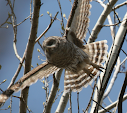
Today dawned clear and cold, as noted in my previous post, but was calm and really pleasant by lunch time. I parked and walked down to the lake, right at the open water and with the sun to my back. Just as I was dialing in the camera and getting ready to get my gull on they all flighted at once. Excited, I turned my eyes skyward to find what had spooked them. I'll take a raptor over gulls any day! As I watched I saw it approaching from the distance...

I was 99% sure that it was a Golden from that view, but I see them so rarely out here that I was hesitant at first. As it approached though any trace of a doubt vanished.


Getting a Golden Eagle on a low approaching pass with good lighting was a first for me. I know I will be back at Erie Res. while the ice lasts to get some gull IDs, but this return trip exceeded my expectations by far.


It is always nice to be rewarded for trying out a new site!


"Thanks Eagle, now go get your fill of gulls so the next time I am around I can try to learn which ones they are! Except of course for the rarities, leave them alone all together!"

1 down - 5 to go!


Here we are one week removed from the Groundhog's prediction of six more weeks of winter. This morning certainly fit the winter bill, with a fresh coating of 3-5 inches of dry fluffy snow, and temps in the low single digits it was definitely a wintry morning. I tried to grab a bit of the early light at Stearn's Lake on my way into the office. Unfortunately, the only bit of open water was right on the east edge of the dam. Its position and the thick cloud of steam really kept me from getting much of a look at the waterfowl that were crowded in. I did see Canada and Cackling Geese, Northern Shovelers, and a trio of Common Mergansers coming in to land. That was it though, the shot above was the first of four I took when I arrived. Just as I did the steam started moving towards me, and blocking my view of the open water.


So I turned my head to the sky and spotted this airplane properly adorned with a snowflake for the weather. I have no idea what the insignia represents, but that was the first time I had noticed that plane taking off from Rocky Mountain Metropolitan Airport. As I was looking skyward I had a flyover from a pair of Western Meadowlarks, they weren't singing today - but a few brave Red-winged Blackbirds were.
Clear skies and warming temps should have this reminder of winter receding into our memories in the next few days, personally I hope to see at least another five this season.

Monday, February 8, 2010

Gulls: Enough to drive one Goofy

This is a post full of gulls and the reasons why I have identified them each as I have. There is a bit of feeding and blood in the last two posts, if that gets you churning, or you just aren't a gull fan skip down to the next post - there is a nice sleeping Owl that isn't at all bloody!


Saturday started off in Broomfield, as I checked out a group of retention ponds in the very northernmost bit of the City and County. There was a reported Glaucous Gull in the area, but I haven't found it in a pair of visits. That isn't saying much though, there are great numbers of gulls that spend their days moving between numerous ponds in the area and I may have just been missing it; and I am really bad with Gulls, so for all I know it may have been right there, or in one of the pictures that follow - but I doubt it. All of my gull IDs, or any bird for that matter, are open to correction or interpretation. I would like to learn after all, so if you see something that isn't quite right please feel free to comment or email. I will be sure to update as well if I find something as I become more experienced. With that disclaimer, I believe the airborne gull above is a third winter Herring Gull. It has pink feet, a distinct ring on its bill, dark primaries and a dark head.

Below, one of the birds is not like the others, that one is a second winter Thayer's Gull. It is large like a Herring Gull, which makes it stand out from the crowd. Here in Colorado the crowd consists of Ring-billed Gulls. The Thayer's in its second year is close in appearance to a Herring Gull of the same age, except the Thayer's Gull has lighter primary feathers. The primaries are the ones sticking out from the back of the bird to the left. They cover the tail, and in the Thayer's Gull are lighter and have a white border at the edge.


Another view of the Thayer's is below, but also included in that view is a possible 1st winter Ring-billed Gull. It seems a bit more brown than the depiction in my Sibley Guide to Birds, but that seems close to fitting. I am a bit baffled that I only found two birds that had that appearance. If they are first years shouldn't there be a few more running about?


Next up are a pair of Herring Gulls. The adult is on the left, isolated against the open water. The third year is on the right, with its wings folded back and up at an angle. The most notable difference between these two is the bill. The adult has the small red mark, showing only on its lower mandible, the third year still retains a black ring across both the upper and lower portions of its bill. Check out the pink feet on both of them! They can be good clues when there are hundreds of bodies huddled together and all of the heads are tucked. There is another, what I am calling, first year Ring-billed in this picture, can you find it?


Now on to gulls doing what gulls do when we humans don't feed them bread or trash. Again, please feel free to skip ahead if you faint when nicking a hangnail or wake up days after glancing at a sushi menu - really they aren't that bad - and if you've made it this far....

Even after looking through lots of pictures at pixelated zooms I can't tell if that is the gull's blood or it's lunch's. It was dunking its head repeatedly in an apparent attempt to rinse it, but it stayed fairly messy while I was there.
At first I thought the gull was injured, but then I got a look at a different section of the pond and was found it more likely that it wasn't. The Herring Gull below was working on a large fish. I had no idea that gulls could catch such large prey, but perhaps they drove a larger hunter away? At any rate this gull seemed to just be getting to the feast, and already had a bit of blood at the base of its bill. So many questions raised by a couple of gulls and a fish!


These ponds seem to be great concentrators for gulls and Common Mergansers (I counted 41 on Saturday's visit and 39 the week before). The are also small enough to allow me to get good looks and pictures to study without needing a scope. So perhaps with more visits I'll be able to say with certainty what types of gulls I saw.

On the track of a Red-shouldered Rarity


Saturday along the Front Range in Colorado was overcast and chilly, but not wet, so a good chance to go after a few of the rarities that had been reported in the area but which I had not yet successfully located. I started the day in Broomfield, looking at gulls, but those are a story for a later post. For the moment I am going to jump ahead, and North, to Weld County. I headed there in hopes of seeing the immature Red-shouldered Hawk, which has been wintering out of range at the Kodak Watchable Wildlife Area. On the way I exited the Interstate a few miles south and swung into the Elwell Cemetery outside Johnstown to check the evergreens. It wasn't a wasted stop, seeing a Great Horned Owl sleep peacefully was well worth it.
Eventually, I did reach the outskirts of Windsor and the Kodak Watchable Wildlife Area. I have been reading reports about this bird for several months now, and on one previous rushed attempt had failed to locate it. This time I was committed though. I had no deadlines to meet, and having visited once before was able to process the descriptions of the birds habits better against the landscape. I heard it before I spotted it, and true to its description, my first glimpse of this easily spooked bird was as it settled into a tree on the south side of the river.

Shooting into the sun through a heavy overcast yielded poor results, but note the high degree of white in the back. That alone wouldn't have sealed the ID, even with my impression of the short single note call that was higher and shorter than that of a Red-tail. But this next shot captured a tell-tale field-mark in an otherwise trashable shot. That buffy patch towards the tip of the wing is a distinctive field-mark for a juvenile Eastern Red-shouldered Hawk. Knowing that the same bird was the one I was looking for helped as well, but I was still happy to find the bird and capture a conclusive - if poor quality - shot.


The Red-shouldered Hawk wasn't the only bird around by any means. A group of 20 Western Meadowlarks were singing in the scrubby trees surrounding a marshy area. Their song, the first I had heard this year, attracted the attention of a Northern Harrier, which was making low slow passes around the area.


Finally, as I returned to the parking lot I noticed a group of large birds in a distant Cottonwood tree. The group of Bald Eagles illustrates the difference between adults and 2nd (possibly one 3rd) year birds. Note how the juvenile looks a lot like a super-sized Swainson's Hawk with the dark bib on a light body? The bird on the left has its back turned and shows the small light triangle across the shoulders and upper back. Again, not the best picture, but one that shows them in the distance against a gray background, much as they often appear when driving along a highway at high speed.


Another post to follow that shows my gull filled visit to some ponds in Broomfield.
2010 Count: 58
Lifetime: 205

Friday, February 5, 2010

First Birdcam Image


House Finches aren't the most unusual species out there, but they seem to like the new Nyjer Seed feeder. Now I just need to clear the condensation that gathered on the lens - oops. Fortunately I now have a memory card loaded so the camera won't be tempted to try to come inside again!

Not Entirely Birdless


Just really close. Not too many good birding opportunities to report this week. I had my truck in the shop for two days getting a few odds and ends done, the basic things that need doing after purchasing a used vehicle. That has been completed, and I am now ready to hit the more obscure and remote roads this spring. Tuesday evening class was a success, I at least completed the assignment! Apparently we don't really get grades, or even very closely scrutinized on whether or not we succeed or fail. Even so, I at least feel like I am getting some structure to push my camera usage. Next week's homework is already in the can so to speak. Two sets of still life images, one black and one white, show the differences in the metered exposures. Good stuff.
I did make a stop on the way to class Tuesday looking for a Glaucous Gull, I didn't find it, but did see the most Common Mergansers, 40, that I have yet to see in Broomfield. We'll see what the weekend has in store, at least a bit of football I'd imagine.
At lunch today I made it out for a bit and saw two Magpies and the photogenic Red-tail above. If it hadn't swung overhead it would have been a bird-less day indeed.

Tuesday, February 2, 2010

Candidates

Along with the two previous sets these are the pictures I am bringing along to potentially hand in for class tonight.

Selective Focus

Depth of Field

Depth of Field


Selective Focus


Depth of Field


Selective Focus


All these pictures were taken at lunch yesterday on one of the area mesa tops. The first two sets were with my telephoto pushed back to its 100mm setting (160mm 35mm equiv). The last set of the rock were at 400mm (640mm)
Biggest lesson learned: How the exposure compensation is controlled on my camera. I almost lost my mind this weekend. I found out that with the shutter release halfway depressed, and the switch set to the squiggly line you can set the exposure compensation value. However, when that hasn't been covered in class and you don't realize that you have actually done it; you begin to wonder if you will ever be able to manually expose a photograph. I just didn't get what I was doing wrong, and the frustration was really getting to me. I wasted a morning shoot on Sunday because the "golden light" couldn't stand a chance against my -2 ev value. Sadly, my 30D doesn't have the best LCD for studying when in the field, so other than knowing that my histograms were showing up way to the side I couldn't really make adjustments. Finally as I wrote up my details today I found the -2 ev value documented and did some extra reading to correct my issue. I didn't get back out today, but am much more confident moving forward. That is exactly the kind of thing I needed to take the class for, and I am glad that I was able to diagnose and resolve an issue, even if it took me the whole week to do so. Some bird posts to come, but for now I am off to class.