Monday, May 10, 2010

Feeder Flight Shots


One of the things I enjoy most about the Wingscapes Birdcam is flipping through a series of shots for the first time and seeing what it has captured. The flight shots that it captures are surprisingly good. I love the shot, (above) of the American Goldfinch slowing down to land. The speed setting captured just the pauses of the wing and tail at the top and bottom of the beat. A shot like that makes me think of a backstroke of a canoe paddle. That first back force in the water which creates eddies and whirlpools which dissipate the forward momentum. Air doesn't let us see that effect from wing-beats, but the cup shape created by the tail and wings would seem to create the same patterns.
The House Finches can hardly avoid getting flight shots with all their activity in the area.

Even the intrusive House Sparrow female, bland as she is, can look graceful when fully extended.


This shot may require a click on the photograph to see, but it captures a House Finch looking on with interest as an American Goldfinch makes a banked approach from below.


I just love that this little camera is hard at work while I am doing other things!

Feeder Variety Improving


A beautiful weekend, overshadowed by a forecast of FEET of snow for my upcoming four day trip to Estes Park and RMNP with my family. Looks like I will be packing some spare winter gear for the family! Despite that news this morning I had a great time Sunday driving my folks around some of the areas near my home that I have *discovered* since their last visit. Doing so, I left the camera at home, and will use the automated efforts of my Wingscapes Birdcam to show some of the more recent arrivals at my feeder.


I saw my first American Goldfinch in the yard late last week, and accordingly this couple had their photo taken to mark the event, (top). House Sparrows (above) aren't new arrivals, or uncommon, but they have taken to the Nyjer Feeder and were regular visitors in my latest batch of pics.
Of course the House Finches are always around as well.


At times the species seem to share the feeder without much visible friction, here a female American Goldfinch and House Finch seem to be tolerant of one another.


A later shot, however, shows that their tempers can flare. This view seems to show a bit of 'communication' between the two.


I am really enjoying the fact that even when I have other activities going on the Birdcam is happy to keep tabs on things for me. My hope is that I will be able to use it on my upcoming trips and take it along camping as well this summer. Any goodies will be shared here, so check back for updates.

Friday, May 7, 2010

Warbler Wowser Wakeup


I had a feeling this morning had a chance to be good. The weather had been socked in last night, and the forecast called for a bright morning with some areas waking up to an overnight dusting of snow. Based on my understanding of "fallout" that seemed about right. Instead of anticipating the predawn bird alarm with dread, I planned for it, and was out the door before six this morning. Everything seemed to have come together perfectly.


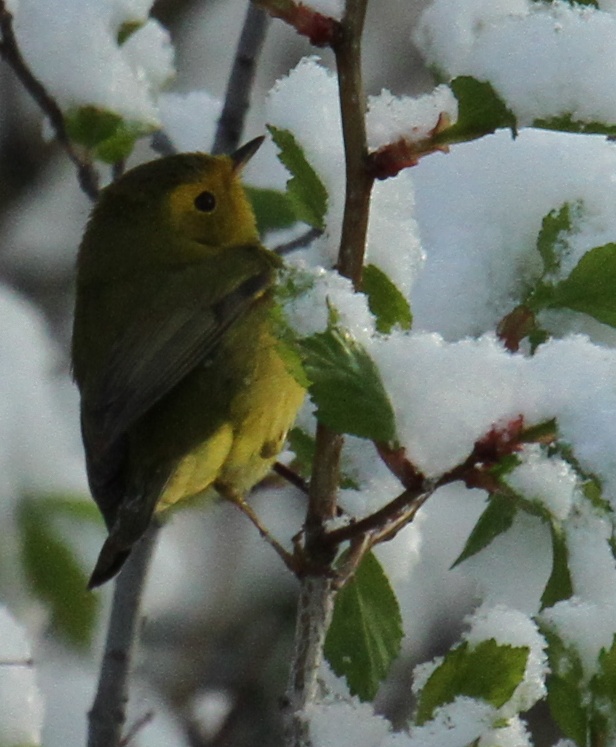
I returned to the South Mesa Trail parking area, and revisited the area where the Worm-eating Warbler had been seen previously. I had no more luck with that species, but it was a banner day for more common varieties of warbler. The Yellow Warbler (top), is one of my favorites. Bright and easily identified, it really works well in pictures. The accumulated snow didn't keep the Myrtel's Yellow-rumped Warbler (above), from enjoying a bit of breakfast. It just plowed off the branch as it went.
Next up was a Wilson's Warbler. It remained deeper in the understory, only occasionally popping up to the higher branches.


Virginia's Warblers were also about. They show that yellow spot in the middle of a plain white breast, and another below the tail. Virginia's also have a reddish crown, (click the picture to get a larger view) and an unbroken, bold eye-ring.


Just like any warbler they always have a next place to get to, and are usually off sooner rather than later.


It was a perfect combination of elements this morning; clear skies and no wind, enough snow to cover, but not so much as to damage the new growth, and colorful migrant birds to share it with.


There aren't many better ways to start a day!


International Bird Migration Day is tomorrow, what species are passing through your areas?
***Update: I found more pics from this trip that had rolled onto a new directory on my camera, the posts are visible here and here.

Thursday, May 6, 2010

Nashville Warbler


Thanks to a fellow birder I was tipped to the presence of a Nashville Warbler in the trees at on of the lakes in my hometown. So, on my way home from work I stopped off for a look. Much to my surprise there were many warblers still actively working their way through the treetops. There were many of both types of Yellow-Rumped, a Yellow Warbler, and offering several good looks was this Nashville Warbler.

One of the most likely species to confuse with the Nashville is the Orange-Crowned Warbler, pictured above. The Orange-crowned has a broken eye-ring, and its breast is a lightly streaked buff color rather than the bright yellow of the Nashville.


It was great to finally get a nice mixed flock of warblers moving through the tree tops. I am glad to have seen a few of these species before the leaves really fill out. Tonight's cool temps should keep the vegetation opening at a slower rate, but may make the migrants reconsider their moves north.

2010 Count: 127
Lifetime: 214

Missing a Twitch - not the worst thing that could happen


Yesterday, a Boulder birder reported seeing a Worm-eating Warbler at the South Mesa Trail. I went for a quick try on a late lunch - and failed to find it. But the Yellow-rumpeds were out in force, and one even shot for a few shots in a row. After looking at my posts from a year back I realized that I had fallen behind my 2009 count at this point of the year. That got me going a bit, so I made a 15 minute stop on the way home at a small lake along the Boulder Turnpike, Hodgson-Harris Reservoir. I approached as close as I was able and with a bit of scanning was able to throw together a list of sixteen species. I added a distant Spotted Sandpiper, and then as I was turning to leave spotted a small bird moving in the dried cattails.

It was another Lincoln's Sparrow! I can honestly say that in the field, with only my camera's eyepiece to scan through I had no idea what species this was. Thanks to my encounter in April, as soon as I had a full picture on my screen I knew that it was a Lincoln's Sparrow. My first series were from a good distance and a bit washed out, but fortunately a cloud crossed the sky and I got a couple later that show a bit more detail. The main field marks to note on the Lincoln's Sparrow are the narrow black streaks on a buffy breast, and the facial pattern that has two buffy mustache stripes and clear eye-rings.


Even though it wasn't a new species, even for the year it was a fun find. As so often happens to me, a recently seen life bird reappears shortly after to reinforce the species. Once again I am left to wonder if the study after initially finding the bird makes the mind more apt to detect it sub-consciously as it enters my environment, or if just having more experience in the field leads to more chance encounters falling closely together. As with all things in life there is probably a bit of both, but it is a phenomenon that always makes me think - what in nature doesn't though?


So, missing a bird kept me seeing cool sights - and I'll take that any day.
2010 Count: 122

Wednesday, May 5, 2010

Recent Arrivals


This morning I awoke to the sound of my alarm, as opposed to the sound of the howling wind and my neighbor's noisy new wind chime. I got away a bit early and was rewarded with a bright beautiful morning with just a touch of cool breeze. I made a short stop at Stearn's Lake, and while walking was able to spot two species that are recently arrived from the south.

The Common Yellowthroat is a bird that I was fortunate to see and photograph early. It is usually found deep in reed beds or cattails. Later in the season looks will be limited to catching this bird as it emerges briefly from its activity deep in the vegetation. This morning, though, I got a few good looks as it alternated between deep under a willowy clump and some dead grass perches out in the open.


I was also pleasantly surprised to find a couple of Lark Sparrows along the path. I like the Lark Sparrow because it's facial pattern is so distinctive. Last year I didn't find them until later in the summer, so it was a nice bonus to get to watch them at the early end of their tenure in this range.

Tuesday, May 4, 2010

April Snow Showers Bring May Wind?


Weird weather and a nasty bout with some bug has kept me away from the birding activities as reports of increasing migrant activity have been pouring in. So while I may still have something in my pictures from a week ago Sunday that will make it into a post I am instead using a few House Sparrow shots I pulled from my Wingscapes Birdcam.


Yesterday, I swung by the Boulder Creek Path, but the wind and creek noise kept me from hearing much, and there weren't many birds in the air. The thirty mile per hour sustained winds today, with gusts reported at 50 mph above that make it extremely unlikely that there will be any birding done before tomorrow at the earliest.