Showing posts with label Insects. Show all posts

Wednesday, September 7, 2011

Critters of Louisiana


American Alligator - star of the show


Monarch Butterfly


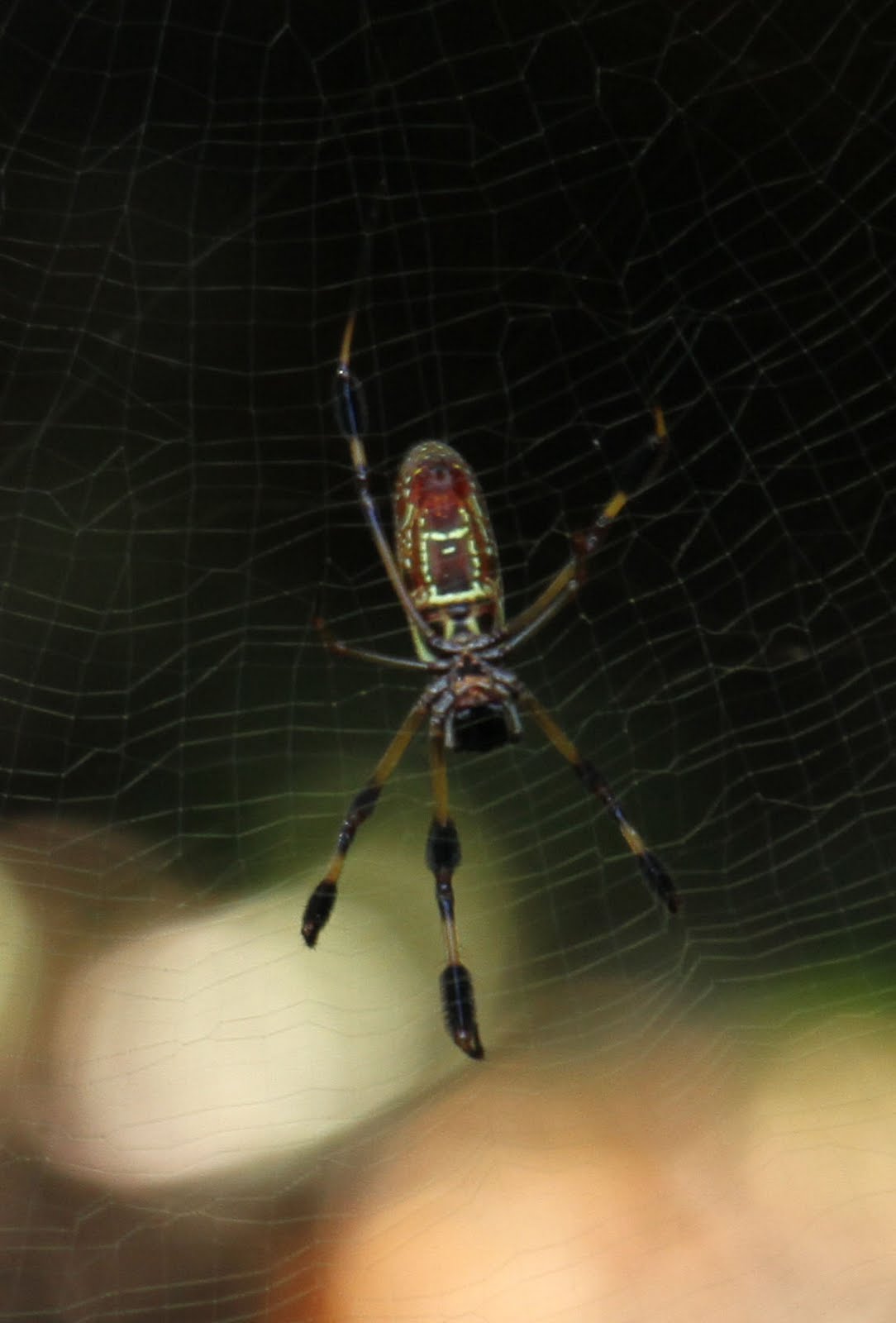
Golden Orb Weaver


Gasteracantha cancriformis, Spiny-backed Orb Weaver or Smiley-faced Spider


Five-lined Skink


Great Blue Skimmer


Golden Orb Weaver


Southeastern Lubber Grasshopper 'Devil's Horse'


Green Anole


Green Anole


Crab (anyone know crab species?)

These were just a handful of the non-birds that slinked, sprang, scurried, spun, swooshed or swam their way past me on my adventures in Louisiana.   Many of the above photos were taken at the Barataria Preserve section of the Jean Lafitte National Park.  That day was incredible, but due to the park opening hour of 9:00 it was already too hot for any good bird activity while I was there.   The place was incredible though, and a definitely recommended destination for visitors to New Orleans.   I even saw a River Otter, (not pictured) which was a lifer mammal in the wild!    

Friday, January 29, 2010

Way Outside the Comfort Zone

I am one who believes that without a plan or goal there is no growth or development. It is why so many of us, (myself very much included), find ourselves wondering where the weekend went, and why everything seems to have slipped into a repeatable routine. This blog has been a part of two years of my life where I have attempted to break that pattern, at least in one part of my life. Two years ago I found that too much of my life was slipping by, with highlights being sporting events viewed on tv or social events that too easily blended with one another. Don't get me wrong, I still like hanging out with friends and watching a good football or hockey game, but I needed something to kick me out of the rut, and make the times that I chose to partake in those activities more meaningful by their scarcity.
So year one was all about getting out of the house more and just spending more time in the outdoors. In October of that year I started actually keeping a bird list and dragging a camera around to see what I could digitally capture.
By the beginning of last year I had found that both photography and birding were pass times that I enjoyed, but that if they were going to be anything more meaningful than replacing time spent watching sports with time spent slowly walking and watching for birds I would have to find a way to push myself. I did so in two ways. First, I fired up the old Blogger and started DaveABirding. It gave a purpose to my photography and also exposed me to a higher level of accountability in my birding. In the past year I have been exposed multiple times posting incorrect species identities. I don't mind making mistakes, it is how we learn, but I find it keeps me much more conservative in my assumptions when I know I will have an audience evaluating my finds.
A bit later last year I pushed myself out of the comfort zone again. I started exclusively manually focusing my shots. Sure for the first few weeks I had a lot of fodder for the virtual cutting room floor, and less quality to post, but in the long run it has really helped me grow. Now I can confidently tighten my focus on a sparrow in some brush, and know that I am getting close to focus on the sparrow's eye, not a clear shot of a branch five feet in front of it.
So to continue to grow I have set several photographic and birding areas for improvement this year. The birding has been mentioned several times in the past, developing an improved ear for bird calls. I have an iPod now with iBird, and the Smithsonian Field Guide with calls, so there is a start, and hopefully I will be able to drive myself to rely more on my ear and develop my mental catalogue from which to draw.
Photography is poised on a more painful growth spurt. I enrolled in my first instructor led photography course. Intellectually the material is not new, I get the concepts of Aperture, ISO settings and Exposure Time, but I do not put them to use in the field. So last Tuesday I was back in school:


My assignment for the first week is to get a pair of images, one displaying Selective Focus, and the other showing Depth of Field, both ideally utilizing the same subject. Easy, right? Well I have my plans for an actual session this week to get some solid pairs, but in two quick lunch time trips I have found myself disappointed in my attempts to just get a pair to have in the bank before hand.
I guess that is the part of learning that we all shy away from, the sting when it doesn't just work out the way our plans tell us it should. Even so, I am really excited to develop skills where I have felt limits in the past, and I am willing to endure some shots to the artistic ego to do so. So goodbye good old 'no flash' mode - for now. I am prepared to do some muddling through for the time being for the greater good down the road.
To that end, and to diversify some of my shooting conditions I just opened a year membership at the Butterfly Pavilion in Westminster. The opening shot was one of my disappointments early, but there will be many more opportunities down the road.

Thursday, September 10, 2009

My Visit to Walden Ponds - Non Birds


While at Walden Ponds yesterday I had many non-bird encounters. There was a Mule Deer to welcome me as I arrived. The dragon flies were everywhere, and my hands bear evidence to the numbers of mosquitoes that became active at dusk.

Many fish were jumping, and this one, (Bluegill perhaps?), was clearly visible in the sunlight.


I also had a great closeup look at this Snapping Turtle. I watched something dramatically moving vegetation as it approached the shore, and was able to wait quietly until it reached the shore below me.
Very cool, bird pics to follow.

Monday, August 17, 2009

Non-Bird Sights while Camping


One of the great things about birding, is all of the cool things other than birds that a person stumbles across. One of the things that caught my eye was this red-topped mushroom. After a bit of searching this seems to be in the Russula family, likely a Russula emetica, "the sickener". I thought the contrasting red and white was impressive, and would much rather observe than sample anyway. I'll leave any taste testing to some other more adventurous observer.


In another area, a higher meadow, I stopped for a bit to watch this White-lined Sphinx Moth. They are similar to, and commonly called, Hummingbird Moths, but when observed are clearly different. The antennae and smaller size are immediate giveaways, but another fun difference is the presence of a curly-cue tongue or proboscis.


Good stuff, of course the one thing seen but not photographed would have made the best picture. It was a Long-tailed Weasel that made a visit to our camp in the late afternoon. I, of course had just sat down across camp from my camera. I was content to watch the carefree visitor, but sadly it didn't return after I had reunited with my camera and waited for it to come back.

Monday, July 13, 2009

Did I just see what I thought I saw?

Well, yes, I did see Dragonflies [update 6/2/2011 thanks to Dave Leatherman for pointing out that this is a Damselfly, not a Dragonfly, specifically an American Rubyspot] on Thursday evening, but that isn't really what had me thinking while I walked in the late day sunshine.


I had stopped to revisit a section of the Coal Creek Trail system rather than sit in traffic at rush hour. While I was walking I received a phone call and was busy talking when something big flew up into a tree from a quiet bend in the creek. With a "I just saw a really cool bird, I'll call you back..." I hung up and started shooting what I could see in the overhead branches.

Seeing the image now and knowing what I do the species is clear, but without the advantage of a full frame and just the size, shape, stripes and a hint of orange I immediately thought I was on to one of the birds I have been keeping an eye out for. A Bittern!
I got about 15 frames before the bird decided that even its treetop perch was too close, and flew off along the trail, in the general direction of the parking area where I had started.
After having inadvertently startled the bird I decided to give it a rest, continue on in the direction I was headed, and try to relocate it before I left.


As I walked I kept thinking, did Bitterns really roost in trees? From what I have seen of them online they frequent grassy wetlands where their stripes give them great camouflage. I held some guarded optimism for the sighting as I returned near the end of my walk. As I got close I kept an eye out, alternating looks between the creek itself and the canopy above. Before long I saw another large bird rise from the limbs, about the same size, but immediately recognizable in adult plumage. A Black-Crowned Night Heron. I held out hope for a few seconds that it might have been a coincidence, that perhaps they were both just in the same area. Sure enough though, seconds later the same bird with the brownish striped markings flew off as well. the two made on brief landing farther down stream, but were off again due to a passing car and soon out of sight.
So instead of a first American Bittern I had my first juvenile Black-Crowned Night Heron - and really that was just as good. Between that and the dragonflies it sure beat sitting in traffic.

Wednesday, June 24, 2009

Goshawk Ridge, beyond the birds


The Eldorado Mountain Open Space is located in southern Boulder County, and encompasses the range of environments that are covered by the generalization, Front Range. Each time I am up there I find my self wondering just how I spent the better part of fifteen years in the area, and am just now beginning to make my visits there a priority. As I have documented in many previous posts the area is one that really resonates with something deep inside me, from the grassy hills around Doudy Draw and Marshall Mesa, to the jagged ridgeline of the hogbacks, and the steep meadows hidden behind outcroppings where deer and elk can be seen grazing from across a canyon.
This particular area has a mining history that is at times hidden away and waiting to be discovered beneath the forest canopy, and at others is plainly obvious to anyone in the area. To access the Goshawk Ridge loop trail on Monday I climbed the initial rise, and then turned right, to head north along the ridge to a road cut. I walked slowly admiring the sharp angles of the steep cut walls. A functionality first road, made in a bygone era - here evidence of the blasting holes wasn't worth the bother of cleaning up. I wasn't alone as the history soaked in. The furry guy below accompanied me through the cut, chatting all the while.

The road swung back to the south as it ran back along the western side of the ridge. On the downhill side a micro-environment of lush vegetation and on my left a much drier rocky slope with some evidence of the fire that had charred the eastern side of the ridge. This was the area where I had located the Black-headed Grosbeaks. In addition I found what I believe to have been some form of apple, growing from below up to the roadside. It was so much bushier than the apple tree from my childhood backyard that I had to take another look. As autumn nears I'll have to check back on that.
On the uphill side I had this butterfly pause. In the field I thought Mourning Cloak, but I now see that it is something different. One more item to put on the lookup list.


In the previous post about this hike I mentioned that at the point where the loop trail crosses over the ridge and begins it descent through the ponderosas that I had stopped to observe a lone mule deer as it munched on some grasses. The wind was in my face, so despite this pause to look at me the deer was content to continue snacking. It was only when the turkeys went past that the deer decided to move on.


Those giant ears are a good indication that this is a muley, but the best indicator for all ages and genders is the tail. On a Mule Deer the tail is narrow with a black tip. It looks a bit like a rope that has just barely been dipped in black paint. On a White-tailed Deer the outside of the tail is black with a white fringe, it shows white when the tail is raised to vertical as this more shy species senses trouble.
The coolest way to tell these species apart is when a mature buck is visible. Look at the rack of antlers, on a White-tail there will be a single forward curved prong with smaller individual prongs growing up and back. Mule Deer have antlers that bifurcate, or split, for each new prong. If you see antlers that split, and then split again you are looking at a Mule deer. This works well if you find yourself in a cabin, lodge, or ski chalet and want to impress your friends while warming the belly, or your feet by a fire.

There were several poppy patches in the meadows, and more individual flowers scattered around the area. The poppies completely dominate the other wildflowers in the area with their large blooms and blaze orange color.
As I approached the car Monday evening my pattern of seeing interesting mammal activity continued. This time it was a fox that crossed the road just below the parking area. He was toting something and being mobbed by two angry magpies. While the pictures I got were two blurry to post I believe he had caught a juvenile. The fact that the fox's load didn't seem to have much life left was lost on the magpies, and did nothing to reduce their rage. One of the more sobering views of the natural world around us, but one that make me appreciate a place like Eldorado Mountain Open Space all the more.

Friday, June 19, 2009

Another great morning at Plaster Reservoir

As seems to be the case, once a new bird becomes identifiable they turn up all over the place. I guess that is fitting for a "Common" Yellowthroat. The one I saw this morning was much more visible perched up in a Russian Olive grove.


On the topic of first sightings, I was somewhat surprised to see that I had not yet gotten an Eared Grebe. Well I did this morning. The salad being pulled up from the bottom seemed a bit much for breakfast, but the grebes, pelicans and cormorants were all wearing green at times.


Keeping on the Grebe trend, this Pied-Billed Grebe was out in more open water further along in my walk.

Plaster is a great spot for waterfowl. I had another add for Broomfield, the Blue-Winged Teal below was showing off his distinctive white face in the sunlight.

Nature wasn't all feather this morning though, I caught sight of this guy on the brim of my hat out of the corner of my eye. In the fly tying world it seems like an emerger for a size 10 hook, I think it looks like a flying shrimp with those tails.


Glad I got up close to early this morning, I didn't have time for another shot at Gregory Canyon and the Scarlet Tanager, but an Eared Grebe is a nice consolation.

2009 Count: 160
Lifetime: 172

Monday, June 1, 2009

Busy Bee


I have a bird post coming from this past Friday in Boulder as well, but had this cool experience with a honeybee gathering pollen and wanted to get a few pics up.

I had noticed the wildflower blooms, and decided to get a picture so I could try to make an identification. That is when I noticed the bee cleaning out the pink and white blooms.


As far as I could see this was the lone individual, but based on the size of those pollen baskets I would imagine there will be more following her back to this area.


I like the pollen already in the baskets, and the extra scattered on her abdomen and head hair. Seems like a good load to me.


Bees do us a great service, are not likely to sting unless protecting the hive or queen, and are currently experiencing an alarming number of failing hives. I know I will keep trying to educate myself and the people I know about the importance of the honeybee and trying to knock down the stereotypes associated with them.

Monday, May 11, 2009

Saturday - Crescent Meadow and Walker Ranch


Went on an abbreviated hike on Saturday with an old school friend who was back visiting Boulder. We headed to Eldorado Canyon state park, and used the Crescent Meadows trailhead to avoid the CU graduation crowds.

The day was perfect, with clear skies and much warmer temperatures than had been forecast. Due to our late start and the mid-day Nuggets game the hike was more about getting there and back in a timely manner than it was about stopping and finding species, but it was great to get out in the sunshine regardless.
The Chipping Sparrows were everywhere in the burn area, I had this one perching on a burned out stump for several moments.

On the climb up to the Walker Ranch trailhead I had great looks at four Turkey Vultures soaring just over the ridge. Always a good sight to keep the coastal visitors moving on the trail!


The Mountain Bluebirds really stand out in the burn area. They generally perch high on the clear limbs and are a bright bit of color against the mostly drab background.


**Update: Comma**

I also had a couple of cool looking butterflies along the way, neither of which I have yet been able to id. There were three of the coppery ones above resting on rocks along the creek, and several of the type below further along the trail.

**Update: Spring Azure**

This one had a brilliant, blue back. Unfortunately it would not rest with open wings, and would not cooperate when flying.
I guess an insect guide is in my future along with a guide to mammals. Those two groups seem much more difficult to ID on the web.
Have a great week everyone, enjoy all the spring going on out there!

Friday, May 8, 2009

Eldorado Canyon State Park


I stopped at Eldorado Canyon State Park for lunch today for the easy lifer, Broad-tailed Hummingbird. They are common sites at higher elevations, and even going the couple of hundred feet up into the canyon made them likely targets.

In addition to seeing them at the Visitor Center feeder I also had them perching up above on the telephone wires headed up the canyon. They are so small and active that getting sharp shots of them in natural perches will be challenging. What I am going to need is a mountain cabin with shaded deck, a comfy chair and some cool beverages, I think I may enjoy that challenge sometime this summer.


It was so nice to be up in the canyon today. The sun was shining and the rocks and dirt had that; hot day, summery smell. It is the smell of hiking out of the forest and onto a dusty meadow trail up close to treeline, bliss.
**Update: Golden-mantled Ground Squirrel**
It took all of my self control to return to the office, but I did, and will enjoy my weekend so much more for still being employed.
On an unrelated note the two species above are thwarting my efforts to identify them online, if you can ID one or the other - specifically - please let me know.
2009 Count: 129
Lifetime: 144

Wednesday, March 18, 2009

Two Fun Surprises


"What do you mean I am not considered a fun surprise?"

Today I decided to try to head east on the Coal Creek Trail system, from the Coal Creek Golf Course where I found ample parking this winter. I quickly found that the trail did not run parallel to the course, but cut away from it, and through a neighborhood towards Dillon Rd. After one wrong turn, (the trail is only identified by a wider sidewalk through the neighborhood), I managed to wind my way through the neighborhood to the "trailhead" where it emerges on the east side.
The potential of this area made the detouring walk well worth it, as it has a great stretch of riparian habitat along the creek, and an open hillside which meets the flat fields that are found north of Dillon Rd. It is an area where I often see Red-tails roosting in trees surrounding a small private pond, and in fact I had spotted a single RT Hawk perched in the trees near that pond from the farthest extent of my detour.
With about five minutes before I needed to turn back I walked along the edge of the golf course to the creek where I saw the Robin above with almost 20 of her friends, and a pair of Black-billed Magpies. (Fine and dandy, but less than I was hoping for on what was going to exceed a two mile lunchtime walk).
Then I saw:


A pair of Red-tails circling towards me, one of whom was continuously trailing both legs below. I had not seen that behavior and will be doing some reading tonight to see if this is seasonal behavior. Do Red-tails clutch one another's talons when selecting mates? Is extended leg flight a precursor to such behavior? I will post an update if I find out.
UPDATE: I took a look at the National Audubon Society's The Sibley Guide to Bird Life & Behavior by David Allen Sibley, I found the following passage:
"Some flight displays are performed by a pair, as when Red-tailed Hawks circle together and chase off an intruder. After such a display, the male floats down to the female from above and behind, dangling his feet and white thighs. As he approaches, the female dangles her feet in the same way, and the pair parachutes a few inches apart in a stately descent to a perch near their nest." p 219.
I saw the pair rising while circling in a thermal, and the arrival of the eagle prevented any stately descent to a nets site, or the copulation which is said to follow. Perhaps it was just a bit of early courting. I should note that periodically both would dangle feet, but the one (male) was persistent, and the other (female) only dropped her feet occasionally.
Unfortunately the pair managed to evade being in a single frame while in focus, so you will just have to take it from me that it was worth watching. It was becoming clear that I was going to have to rush back on my return trip and that I really needed to leave, when out of nowhere:

A darker third party arrived. Compare that wing silhouette to the Red-tails in previous posts, the wings appear uniformly broad, and show long primary feathers at the tips. As I had been watching the Red-tails had been moving towards the sun from my position. So from my position below at the time it arrived the third bird appeared uniformly dark. It could have been either a Vulture or an Eagle based on wing structure.
Here is a closer crop of the bird as it announced itself to the Red-tails:


Note the size and shape of the head and beak. A Turkey Vulture has a small, featherless, head and a small beak designed to help it pull morsels of meat from carrion. This bird has a large head, and a large thick beak. It is an Eagle, likely a Golden rather than an immature Bald Eagle based on local observation patterns, and some worse focused pictures that grabbed a hint of color from the head.
The second surprise of the day was one that I would never have appreciated until I spent some time reading the Birdchick's Blog. She started keeping bees, and through her posts regarding her experiences I learned a great deal more than I could have imagined possible. (From my perspective honey is great, it comes in a bear shaped dispenser at the grocery store).

Anyway, as I walked back towards my car I spotted yet another sign of spring:


A beehive in a hollow tree. I don't think I would have been as quick to note the bees arriving at their hive if I had not read about their habits, and I never would have noticed anything special about the slightly larger yellow patches on her legs. Just knowing that the picture is of a female bee shows that I learned a lot.
Those yellow patches are pollen baskets, and are what the bees store the pollen that they gather from flowers in on their return flight to the hive.
That is one of the great things I love about nature, reading about a behavior or species, and then getting to see it in real life. In this case I had the immediate ah-ha moment of spotting a wild hive, and then a second, when I discovered the full pollen baskets when I was reviewing my pictures. Double bonus for me!