Showing posts with label Walden Ponds. Show all posts

Tuesday, September 28, 2010

Walden and Sawhill Ponds - Rails and Yellowlegs

Saturday morning offered many more species than sparrows to observe. I saw three shorebird species of particular note.

The Sora:


A life bird for me, and one that is common in wetland habitats around the state. I am glad to have made its acquaintence and hope to see more.


Another was the Virginia Rail, which is actually a fairly close relative of the Sora. The two are the most common Small Rails and are in the family Rallidae along with the Large Rails, Moorhens and Coots. (The Sibley Guide to Birds). They share size, shape and feather coloring, but even in the poorly angled picture above the tell-tale long orange bill is visible, making the second bird a slam dunk Virginia Rail.


I also had two distinct looks at a single Greater Yellowlegs. A first sighting for me in 2010. This bird is tricky to distinguish from its smaller counterpart, the Lesser Yellowlegs. Apart from general size the bill is the best way to distinguish the two, or so I have read repeatedly. The Greater Yellowlegs has a longer bill that upturns slightly, while the lesser has a bill that is about the same length as its head, and remains straight. Of course I am still seeking a Lesser Yellowlegs, so I have yet to see the distinction for myself. Not having personal experience with both of these species I welcome feedback if my identification is off.


As always it is fun to see new birds. The Virginia Rail I had seen in Wyoming, but never before in Colorado, and had never photographed adequately for posting. While none of the shots are eye popping, they are ones that help me to confirm what I have seen in the field, and can be used in the future as a comparison.

On an unrelated note I wanted to share a book note for any Colorado Birding readers who may find themselves in a similar state of enthusiastic, if far from expert birding. I was pointed to "Colorado Birds - A Reference to their Distribution and Habitat" by a fellow Colorado birder after posing a question about arrival and departure dates for Winter Wrens in Boulder County. I looked through it at the library and immediately decided that it was a book I needed for my home reference. The book was written by Robert Andrews and Robert Righter and published by the Denver Museum of Natural History back in 1992. It provides an entry for each of Colorado's then 443 recorded species of birds, as well as a great front section dedicated to the various habitats and regions of the state. This book is not a field guide in any sense. Each species shows a map of its range in Colorado, charts of both seasonal occurance and elevation, and a write up of its rate of incidence in various portions of the state. This is going to be a great sanity check reference for me, and one that I would recommend to others as well. I couldn't find it being sold new through any of the major online retailers, but I got a great used copy for less than the original price after shipping. If nothing else go check to see if your local library has a copy. I couldn't see myself checking it out, but would swing by to check on something if I was really stuck.

2010 Count: 199
Lifetime: 243

Monday, September 27, 2010

More Fall Sparrows


White-crowned Sparrow


I have never been one for definitives. Ask me what my favorite food is, and I can give you a list; music, depends on the mood; movie, yeah right; book - even worse. So naturally I am not one to play favorites in nature, but even so I have a tough time passing on fall as a favorite time of year. Don't get me wrong, winter spring and summer all have their strengths, but I think it is the variety of fall that really captures my interest. The colors and the weather are constantly changing. An early frost may be followed by a week in the 90's, and by the end of fall, (a week before the Christmas Holidays), winter will have fully arrived, or in Colorado it will have at least made and appearance.


Lincoln's Sparrow


For now, around here colors are achieving their full tones, and birds have been moving through steadily. Fall also seems to be a season when my time is pre-allocated, mainly by football games and old friends returning to watch football games. So birding takes a bit of a hit, but it just makes those times when I can get out that much more memorable.


White-crowned Sparrow


The visit I had to the Walden & Sawhill Ponds complex in Boulder was certainly one of those. On a walk there with a roommate and dog I saw these sparrows and a good number of other species as well. Another post to follow with a pair of new species for the blog...

Sunday, April 11, 2010

Mink


In addition to seeing my first Lincoln's Sparrow yesterday I also added the Mink to my Mammal list.


I guess another advantage of early spring, I saw a brown shape moving across a muddy marsh area where the grass was just springing up. Conveniently, it decided to pause and do a bit of scanning, allowing me to get a few shots.


I got to see this one take a swim across the pond, which is appropriate as Mink spend much of their time in and around the water.


In fact, this one tipped off it's burrow location in the bank as I watched. Perhaps I will get back at some point to see if I can improve the pics.


I was surprised at just how Ferret like they are in their actions. Both species are closely related, so it makes sense, and makes the Mink a fun species to watch in the wild.

Boulder Habitat Delivers Again


Migration seems to have reached full pitch, in the midst of my pager weekend. Having a short leash I decided to head back to the Walden / Sawhill Ponds Complex in Boulder County yesterday morning. The trip didn't disappoint. 34 species in a couple of hours, including a handful of returning winter migrants, a bunch of favorites, great weather and two lifers - this bird and a mammal.

The Lincoln's Sparrow can be difficult to find because like some others it spends most of its time deep in thick brush. I was lucky, as I walked along a narrow, willow covered rise separating two ponds I heard some movement in the brush as I passed. I stopped a few feet beyond and looked back with the sun. Eventually I was rewarded as this bird perched several times in spots that allowed me relatively good looks through the branches.


At the time I had no idea what I was seeing, just that the buffy malar stripes, (the line that runs down and away from the bill, below the eye), gave me a pronounced impression of yellow in the field, and that it was a mark I couldn't place to a species with which I was familiar. In addition to getting the pictures I made some notes in the field to help me with my identification later. I noted that there was faint striping at the neck and shoulders, but that it didn't feature on the breast, which was plain gray.
When I got back home I checked the pics, zooming in for detail, and dove into the field guides to knock out an ID. I eliminated the Le Conte's, Henslow's and Nelson's Sparrows, because while all have yellow on the their malar stripes or regions, in all cases it reaches above the eye. I then found the Lincoln's and was glad to be able to match up all the field marks indicated with my shots and notes. Then I checked against the archives of the COBirds mailing list to make sure that the timing was right to have a sighting in this area. To my surprise I found that someone had reported one from the same area, at a different pond, only four days before. I had read the alert, but didn't register the sparrow, or dismissed it as one that I would be unlikely to relocate. I'm still not sure if that is a good indication to recheck reports before heading out, or to trust to dumb luck when in the field. Either way I was ecstatic to have a new bird for my life list, and confirmation ready waiting for my new I when I got home.


Really quite a handsome bird, when it decides to make itself visible.
2010 Count: 103
Lifetime: 212

Thursday, September 10, 2009

My Visit to Walden Ponds - Shorebirds and a Snowy


One of the highlights of yesterday's hike was a few minutes spent at a small pond just before sunset. It was the place to be if you were a shorebird. With my usual disclaimer, (I may be way off on shorebird IDs), enjoy and feel free to correct me where appropriate.

The Solitary Sandpiper, above, was one of a group of three - not feeling so solitary, apparently.


While the Wilson's Snipe was foraging all by itself.


Of course Killdeer were everywhere, and the Snowy Egret below was in the same pond, and just looking too good not to include here.


Good birding all!

My Visit to Walden Ponds - Non Birds


While at Walden Ponds yesterday I had many non-bird encounters. There was a Mule Deer to welcome me as I arrived. The dragon flies were everywhere, and my hands bear evidence to the numbers of mosquitoes that became active at dusk.

Many fish were jumping, and this one, (Bluegill perhaps?), was clearly visible in the sunlight.


I also had a great closeup look at this Snapping Turtle. I watched something dramatically moving vegetation as it approached the shore, and was able to wait quietly until it reached the shore below me.
Very cool, bird pics to follow.

My Visit to Walden Ponds - Grebes and Ducks


I had an early morning start at work yesterday, which meant a long free afternoon! I spent it at the Walden & Sawhill Ponds complex in north Boulder. There were lots of birds out and about, I tallied 32 species, one of which - American Bittern - was a lifer, but remained unphotographed. (I saw two individuals fly overhead at dusk and was unable to relocate them in the lake where they landed amongst the log grasses). The waterfowl as always were prolific. I had Wigeons, Blue-winged Teal, Wood Ducks, Canada Geese, and the Pied-Billed Grebes and Mallards pictured in this post.


The little grebe below is still showing the facial markings and orange bill of a hatchling. I stumbled upon it rooting in the muddy waters of a small pond. I was surprised that it was able to dive and resurface in more open water on the other side of some vegetation in what appeared to be only inches of water.


Enjoy, the signs of fall are beginning to show.


2009 Count: 181
Lifetime: 189

Tuesday, July 7, 2009

Begin the Day with Birds!

What better way to motivate for a workday than at a lake, at sunrise, surrounded by the textures and colors of birds?


Mourning Doves are common, but the low sun shadows make the spots on this one's back merge into the layers of texture. Even the mundane can provide beauty.


A Song Sparrow's song is just right to clear the mind and rejuvenate the soul.


This young Bullock's Oriole explores all the ways a barbed wire fence is like a jungle gym. Even prickly situations can be fun.


The subdued colors and contemplative nature of this Double-Crested Cormorant offer a reminder, that reflection and patience have their places in daily life.


Then an American Goldfinch finds a perch under cool green leaves and before a crystal clear blue sky. Make the most of conditions that favor your best qualities!
Finally, never be content with the way things are. The familiar may not be the best, be open to change if it brings an improvement! (Check out the new and improved Great Blue Heron header!)

No Mercy

Caution! The following post is a bit of a downer, no graphic images, but some of the tough realities of nature are explored. If you prefer a less challenging, more warm and fuzzy experience please stop reading - click here for flowers and bunnies, or wait for the typical bird pics from the walk post that will follow.


This guy or gal almost wrecked my mood today. The sun had only been up ten to fifteen minutes, and I was walking back from the east side of the large lake, (typically mudflat), when I saw a lone Canada Goose swimming towards me. It was riding low in the water, visibly struggling to reach the bank. I couldn't tell if it had a wing or foot problem, or if it was something else. In any case it was clear that if it didn't get resolved shortly the goose would not be long for this world. Granted, that part of the situation is a bummer, but it is a part of the way the natural world works. I have watched enough predators devouring perfectly healthy prey that the sight of a doomed injured animal at the very least doesn't make bloggable material.


What did was the response of three other geese to its desperate calls as it neared the bank. It had been using its wings to keep itself above water and looked and sounded exhausted. Then, one of the three geese in the area started honking loudly. It placed itself between the distressed goose and the shore and began to defend the territory.


It drove that individual away from the bank, and back out into deeper water. I walked away with plenty of thoughts to chew on - I didn't need to stand around and watch what I can imagine was the eventual outcome.
The question is, do geese drive away all injured or otherwise distressed members of their species? Having volunteered in a raptor rehabilitation clinic, and read examples on the web, I know that there are many bird individuals that cope with injuries, malformities, and other maladies and get on quite well. Since Canada Geese are frequently seen in large groups I have to imagine that the defensive response was specific to that bird, and not something that would have been presented to a healthy individual, but I could be wrong there.
That lead me to a next question, are there certain disease conditions amongst birds that can be recognized, and cause banishment - like leprosy?
Fortunately there were many other sights to see this morning, and the thoughts of rejection and death were chased away by bright sunlight and birdsong. Even so, I am curious if anyone else has encountered this or similar behavior. Any experts out there that can offer any insight are welcome to comment or email me.

Cottonwood Marsh and Walden Ponds - non bird


I love getting up before sunrise and starting the day outdoors! I also love staying up late, being with friends and all kinds of non-nature activities, so the early start mornings are few and far between. When they do happen though, they are almost always worth the horrible wake up time.

Of course the main intent of my walk was to see some birds, but wildflowers and mammals made their bids to steal the show. I have no idea what the bloom above is, there were a handful of them growing along the boardwalk in the now flooded Cottonwood Marsh.


Same goes for these purple jobs, but the sunlight catching on the tiny drops of dew makes them look impressive.

Not that this furball stopped to notice, the dew just makes them that much juicier.


Clear blue sky and bright colors make a great start to any day! The ladybug and gnat may not have appreciated the setting, but I sure did.

Tuesday, April 14, 2009

Monday at the Marshes

I wanted to get back up to the Cottonwood Marsh, Sawhill Ponds, Walden Pond area in Boulder now that the migrants are arriving. Monday, being the day I get off work at 3:00 was the perfect opportunity.
Before heading up I checked the recent emails that referenced the location and knew that both Mew Gulls and Black Phoebes had been spotted recently. I did a quick lookup on each so that I would be prepared to identify them if I saw them. (I didn't see either, but it seems like a good way for me to prepare for trips, and learn about likely species before I see them.)
At the entrance to the complex I was checking the Cottonwood Marsh mudflats for shorebirds when a couple passed me and told me that if I wanted to take pictures I should head over a couple of lakes to one where 50 or so Pelicans were feeding.
The complex is large - there are many different lakes, marshes and woodlots to explore. As such it is always nice to get a target destination right off the bat. I headed over and sure enough there were a large group of Pelicans feeding in the lake.


I initially counted 66, and another dozen arrived in pairs or solo while I was watching. Carry a camera and binoculars around a nature preserve and you will quickly find that others in the area immediately consider you an expert....either that or they were testing me. I started getting questions about how long the Pelicans would stay, and whether or not the American White Pelican was the largest bird in Colorado.
Anybody know the answer to that one? I said that I wasn't sure, but that some of the swans or cranes may be larger.

The Pelicans were fun to watch, and I hope that some of them hang around. This one successfully caught a fish and was happy to show it off.

Just to the north of the Pelicans I spotted a Great Horned on her nest, and just around the corner - west of the boundary - there was a fairly developed Great Blue Heron rookery. It looked like the pairs were still in nest building mode, but getting back there with some morning light will have to be a priority.

I spotted this bird from across a lake and despite being the first one I had seen in the wild I knew it immediately.


Osprey! When perched with their wings folded their white heads can look a bit like a Bald Eagle, but the black eye band/cheek patch gives them away, as does their white belly from below. I really like this bird, and got the opportunity to direct a late arriving birder towards it as I was heading back to the entrance.


In an area like this heading back is an hour proposition, and I still had plenty of time to enjoy the American Wigeon seen here and all the other waterfowl as the sun sank.
I stopped by the spot where I had listed my first Great Horned Owl back in January, and there were two sitting in the next tree over. Back to back days seeing three Great Horneds, I am getting spoiled!

In addition to the great Owl, Pelican, and Heron sightings I added three new life birds on my trip. As well as the Osprey pictured above I got a Barn Swallow (not even close to pictured), and a Black-and-White Warbler (pictured but too small and far to show up well on the page). The day was very good, I got 35 species between three stops and just enjoyed a long enough afternoon that I could almost bird/hike 5 miles before it got too dark to continue.

2009 Count: 83
Lifetime: 107

Sunday, January 25, 2009

Walden & Sawhill Ponds


Another great day at a location I found via the Colorado Field Ornithologists' Birding by County site. This time it was a pair of preserves in northeast Boulder called Walden and Sawhill Ponds respectively. They are managed by different agencies, and are separated by a small fence with multiple access points. For the wildlife they make one large habitat with numerous lakes, ponds and marshes.


After seeing many Ring-billed Gulls, Mallards, Canada Geese and American Wigeons I spotted a juvenile Bald Eagle soaring above me.
Later I saw two adults soaring hundreds of feet above a human glider being towed aloft by a prop plane. That would have made a great picture, but trees and distance prevented it.
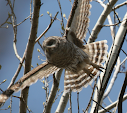
I got over it quickly though when I finally spotted a Great Horned Owl. This has been my most frustrating species since I started listing. I had decent pictures of one last spring in the wild, and worked with them enough at Birds of Prey to have one mistake me for a tree, but had not seen one yet that I could confirm since last October. I knew that they were out there, and that when I did find one it would be closer than I expected.


Sure enough this guy was sitting directly behind me at eye level. When I first spotted him he was on my sunny side and I couldn't get much detail.


I gradually worked my way around him at a safe distance.


What a magnificent bird!


These two were swimming on a larger lake as the sun began to sink behind a storm cloud on the mountains, a good portrait of Ring-necked Ducks.
As I took their picture movement erupted across the lake.


Another Great Blue Heron!


Two on back to back days is a nice trend, hopefully this means more owls soon.
Immediately after I saw what may have flushed him, this cool looking intermediate Harlan's Red-tailed Hawk, (also pictured at top).


He would have had more than he could handle with a great blue, so perhaps they were flying coincidentally.....
either way I'll take it.


The contrasts in that bird are very nice.


An excellent place for birding, and the Great Horned is a nice add to the list.

2009 Count: 56

Lifetime: 86