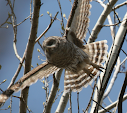
Whatever that little bug is, it decided to tempt fate a bit on Tuesday afternoon. Flying within inches of a perched Western Kingbird would seem to be a life expectancy limiting move on its part. So did the bug decide to high-tail it out of there, nope.....

It went in for a closer look. Gutsy, and for whatever reason that particular Western Kingbird was content to watch rather than reaching out for an easy snack.
Tuesday was particularly smokey, on that day the fire was still generating a billowing cloud of smoke. The inversion had lifted shortly before, and as I stopped by Singletree Trail the fire bombers began a constant rotation overhead. The day offered a great collection of kingbirds, mostly in the form of a group of Eastern Kingbirds, which seemed to have flocked for migration. Just watching them repeat their aerobatics again and again was a boost for the day, but on my way back I had another surprise.

A tiny bird popped out of the undergrowth at my feet. I sent the following to the COBirds mailing list, because after checking my resources I wasn't sure if a Winter Wren should be expected in Colorado at this time of year:
"...if anyone could advise me on whether a Winter Wren has any degree of likelihood in Colorado in the first week of September, I would appreciate it. This afternoon at apx. 2:30 pm I was walking along the Singletree trail just SW of old Superior. From the trailhead heading west there is a good stretch of heavy brush on the right (north) side, then an old tailing hill, and immediately to the west a group of large cottonwoods. I was directly under those trees shooting photos of some Towhees and Doves out in the distance when I heard a rustling in the low groundcover at my feet. My impression was 100% mouse - it was making small moves out of sight, in thick vegetation 4-6 inches high, but its progress could be perceived as it moved around. I was completely surprised when a tiny Wren popped out almost at my feet. I didn't even attempt a photo, my lens was extended and focused way beyond something that close, and motion would have sent it back to cover even faster. I had 2-3 long seconds as it turned at my feet. My impression was an overall chocolate brown bird, with very limited markings. It gave a couple of short, exposed hopping moves at my feet, flew a short distance to the fallen trunk, and then dove to the larger shrubs beyond. It did not reemerge, and I did not pick up any notes or calls, (but fire bombers are flying directly over the site repeatedly this afternoon). There is a dried creekbed to the north, but I am not aware of any open water near the site. "
I did return to the site that evening and the following morning, but never heard a call, or saw the bird again. I did receive several responses confirming that Winter Wrens were seen in Colorado in Sepetmeber, and that the species fit the description. I had hoped to get a chance to photograph that bird to share, but guess I will have to continue to watch for it. Instead, how about a pair of Eastern Kingbirds?

Finally a recognition out to all the firefighting resources that are working on the Four Mile Canyon fire outside Boulder. The fire has made the national news cycles, so the details are well known, but despite remaining stationary through a pair of calm days the weather is supposed to turn dry, clear and windy - and so the situation may be about to get worse. So far the Betasso Preserve has been just outside the burn area, to the SE, and based on the reports that is the area where some degree of containment has been achieved. However the forecast wind is supposed to be coming in out of the N - NW, so it could be gone quickly. Any direction the fire moves will be bad though, and this is already being called the worst fire in Colorado's history.

I guess in life we are all a bit like the bug. The residents in the foothills of Boulder County trade an ever present risk of fire for the chance to build a home in truly beautiful country. Some, like the bug may luck out and find that the fire has spared their homes by mere inches, while others will have lost everything and have to start anew. Fortunately, all that has been lost so far is replaceable - lets hope that all those working in and around the fire zone remain safe and keep it that way.
I did return to the site that evening and the following morning, but never heard a call, or saw the bird again. I did receive several responses confirming that Winter Wrens were seen in Colorado in Sepetmeber, and that the species fit the description. I had hoped to get a chance to photograph that bird to share, but guess I will have to continue to watch for it. Instead, how about a pair of Eastern Kingbirds?

Finally a recognition out to all the firefighting resources that are working on the Four Mile Canyon fire outside Boulder. The fire has made the national news cycles, so the details are well known, but despite remaining stationary through a pair of calm days the weather is supposed to turn dry, clear and windy - and so the situation may be about to get worse. So far the Betasso Preserve has been just outside the burn area, to the SE, and based on the reports that is the area where some degree of containment has been achieved. However the forecast wind is supposed to be coming in out of the N - NW, so it could be gone quickly. Any direction the fire moves will be bad though, and this is already being called the worst fire in Colorado's history.

I guess in life we are all a bit like the bug. The residents in the foothills of Boulder County trade an ever present risk of fire for the chance to build a home in truly beautiful country. Some, like the bug may luck out and find that the fire has spared their homes by mere inches, while others will have lost everything and have to start anew. Fortunately, all that has been lost so far is replaceable - lets hope that all those working in and around the fire zone remain safe and keep it that way.
2010 Count: 197
Lifetime: 242